
SEO for Lawyers: The Ultimate Guide to Law Firm SEO in 2026

The way clients find and choose attorneys has evolved. Search engines, AI platforms, review ecosystems, and digital authority signals now influence nearly every legal hiring decision. For lawyers, visibility is no longer about ranking for a handful of keywords. Modern clients rely on a combination of organic search, local search, AI summaries, and third-party sites to decide who to trust.
This guide explains everything you need to know about SEO for lawyers, including foundational elements of law firm SEO, emerging AI SEO practices, and advanced strategies that help your firm stand out in an increasingly competitive digital landscape.
If you need assistance managing your law firm’s SEO and AEO (Answer Engine Optimization), we invite you to call our office at 520-261-8645 to schedule a free consultation with an SEO expert.
CHAPTER 1 — Introduction to Law Firm SEO
What Is Law Firm SEO and Why Does It Matter for Attorneys?
Law firm SEO (often referred to as SEO for lawyers, attorney SEO, or SEO for law firms) is the process of improving your firm’s online visibility so potential clients can find you at the exact moment they need legal guidance. Unlike many industries where consumers browse casually, legal searches are driven by urgency. Most people contact only one to three attorneys before making a hiring decision, and their choice is heavily influenced by what appears in search engines and AI-generated summaries.
Effective lawyer SEO ensures your firm shows up when individuals search for terms such as:
- “personal injury lawyer near me”
- “divorce attorney in Austin”
- “criminal defense lawyer”
- “estate planning attorney”
These searches almost always occur during life events that affect a person’s freedom, finances, family structure, or safety. For that reason, online visibility is not a marketing luxury. It directly determines who a client calls first, who gains their trust, and who ultimately earns the representation.
A strong SEO foundation connects your firm with clients at the moment they are evaluating options, comparing reputations, and deciding their next step. Without it, even highly skilled attorneys can be overlooked simply because competitors appear more prominently across Google, local search, and AI-driven platforms.
How Is Lawyer SEO Different From General SEO?
Google classifies legal content under the YMYL category. This means law firm websites must meet significantly higher standards for accuracy, trust, and professional credibility. Unlike industries where generalized content may rank, attorney SEO must be grounded in real legal knowledge and verifiable authority.
Key differences include:
- Higher Standards of Accuracy
Google requires legal content to be factually correct, reliable, and written in a way that does not mislead or oversimplify complex legal issues. Thin content or generic writing is not enough to rank.
- Authority and Trust Signals Are Mandatory
Law firm websites must demonstrate that real attorneys are behind the content. This includes strong attorney bios, bar admissions, credentials, awards, case involvement, publications, and cross-platform citations.
- Competition Is Significantly Higher
Personal injury, criminal defense, employment law, family law, estate planning, and immigration are among the most competitive SEO sectors in the world. Firms that do not invest strategically cannot compete, especially in the age of AI answer engines.
- Local Intent Plays a Major Role
Most legal queries are local (“lawyer near me,” “attorney in Portland”). Ranking requires a combination of traditional SEO, local SEO, and structured local content.
- Ethical and Advertising Rules Apply
Content must comply with state bar guidelines. Over-promising, misleading statements, unverifiable superlatives, or improper claims can create risk. As an attorney-led SEO team, we understand these rules deeply.
- AI-Driven Search Is Already Shaping Visibility
AI summaries and answer engines now influence how often clients even see your website. If your law firm is not optimized for AI, you may be excluded from emerging search formats entirely.
Because of these factors, law firm SEO requires an attorney-led, precision-driven approach. It cannot be treated like generic service-business marketing or outsourced to freelancers who do not understand the law. Legal content must reflect real legal reasoning, understand statutory nuance, anticipate client concerns, and remain compliant with professional-responsibility rules.
Why an Attorney-Led SEO Approach Matters
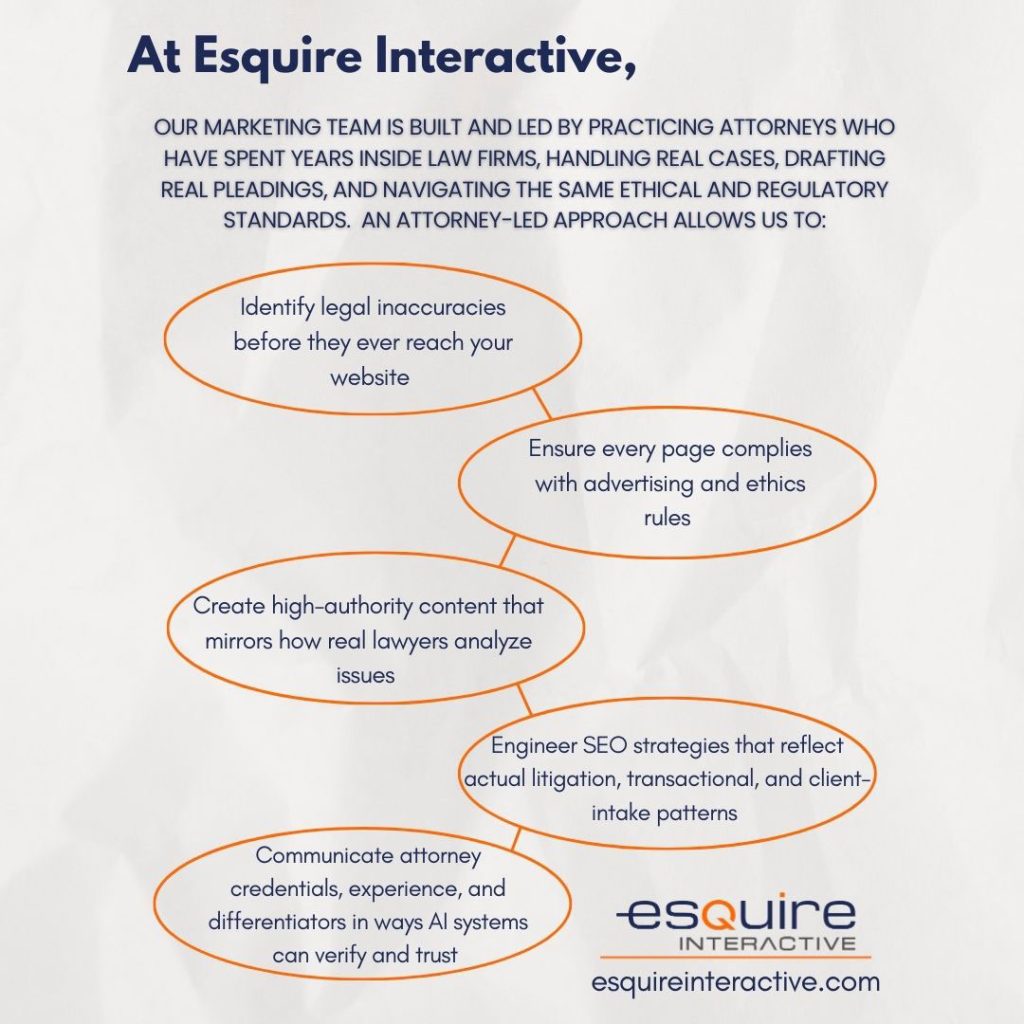
At Esquire Interactive, this is where we stand apart. Our marketing team is built and led by practicing attorneys who have spent years inside law firms, handling real cases, drafting real pleadings, and navigating the same ethical and regulatory standards your firm faces. With several attorneys on staff, we do not need to “guess” what makes legal content authoritative. We write and optimize content the way attorneys think, the way regulators expect, and the way clients search.
This attorney-driven structure allows us to:
- Identify legal inaccuracies before they ever reach your website
- Ensure every page complies with advertising and ethics rules
- Create high-authority content that mirrors how real lawyers analyze issues
- Engineer SEO strategies that reflect actual litigation, transactional, and client-intake patterns
- Communicate attorney credentials, experience, and differentiators in ways AI systems can verify and trust
Most importantly, our legal background gives us a competitive advantage in the age of AI answer engines. Large language models rely on factual, cross-verified information from credible legal entities. Because we understand how AI systems interpret legal authority, we build content and digital ecosystems that reinforce your firm as a reliable, citation-worthy source.
The result is a level of precision, compliance, and strategic insight that traditional marketing agencies simply cannot match.
Why Does Consumer Search Behavior Make Lawyer SEO Essential?

Nearly all legal matters now begin with a search engine. Clients look online to understand their problem, evaluate their options, and determine which attorney to call. Even when a prospective client receives a referral, they still verify that attorney’s reputation by searching their name online.
People search for:
- Answers (“What is comparative negligence?”)
- Options (“Best personal injury lawyers near me”)
- Next steps (“How do I file for divorce?”)
If your website does not provide clear, helpful information during any of these stages, potential clients will find a competitor who does. Law firm SEO ensures your content satisfies these needs and positions your firm as a trusted legal authority.
How Do Search Engines and AI Shape Public Perception of Your Law Firm?
Your visibility in search engines and AI platforms now functions as a public reputation marker. When your firm appears consistently in organic search results, map listings, featured snippets, and AI-generated summaries, potential clients perceive you as established, credible, and actively engaged in your practice area. Search engines reward firms they trust, and clients interpret that visibility as proof of competence.
The opposite is also true. When your firm does not appear prominently, prospective clients often draw conclusions such as:
- You may lack experience
- Your firm might be too small or understaffed
- You may not handle their type of case
- Something seems uncertain or inconsistent
These assumptions form instantly and privately, long before a client ever calls your office. Even if they are completely inaccurate, low visibility can give the impression of low authority.
In today’s landscape, digital visibility has become inseparable from professional reputation. Ranking well is no longer simply a marketing advantage. It is a credibility signal that shapes how clients evaluate your experience, reliability, and overall trustworthiness before they ever speak to you.
CHAPTER 2 — How Law Firm SEO Works

How Do Search Engines Evaluate Law Firm Websites?
Search engines evaluate attorney websites using a layered process that examines technical health, content depth, user behavior, and entity authority. For law firm SEO, this process is especially rigorous because legal queries fall under Google’s YMYL standards.
Evaluation happens in three stages:
- Crawling
Search engines discover your pages and assess whether the site is built in a way that allows efficient access. Proper structure, internal linking, and clean URLs ensure Google can reach every important section of your site.
- Indexing
Google stores eligible pages and analyzes them for relevance, clarity, and topical relationships. Law firm websites must provide detailed, accurate explanations of legal concepts, practice areas, and state-specific procedures.
- Ranking
Google matches indexed pages with user intent. Here is where SEO for lawyers becomes highly competitive. Ranking is influenced by:
- Depth and precision of legal content
- Clear, structured practice-area silos
- Demonstrated attorney experience
- Mobile usability and load speed
- Page engagement (scroll depth, time on page, bounce rate)
- Schema markup for attorneys, services, and locations
- Strong internal linking that reflects your service offerings
For SEO for law firms, ranking is not determined by keywords alone. It is the sum of how well your site communicates legal knowledge, attorney authority, and real-world credibility in a format search engines can easily interpret.
How Does Google Determine Trust and Credibility for Lawyers?
Google evaluates trust for legal websites using a combination of E-E-A-T principles (experience, expertise, authority and trustworthiness), professional signals, and online consistency. Law firm websites must show that real attorneys are responsible for the content, and that the attorneys have verifiable credentials.
Key trust signals for lawyer SEO include:
- Robust attorney bios with bar admissions and jurisdictions
- Detailed practice-area pages
- Evidence of real legal experience (case involvement where permitted, speaking, publications)
- Mentions in media, interviews, or authoritative legal sites
- Strong reviews across multiple platforms
- Accurate NAP information across directories
- Professional imagery and attorney headshots
- Consistent profiles on Avvo, FindLaw, Justia, and bar associations
In the AI era, off-site signals now influence rankings as heavily as on-site content. AI platforms often provide answers without sending users to your website. They rely on cross-verification across the broader web.
If your firm appears consistently and accurately across trusted platforms, Google and AI systems recognize you as a confirmed entity. If details conflict, authority weakens.
How Does Search Intent Affect Lawyer SEO Rankings?
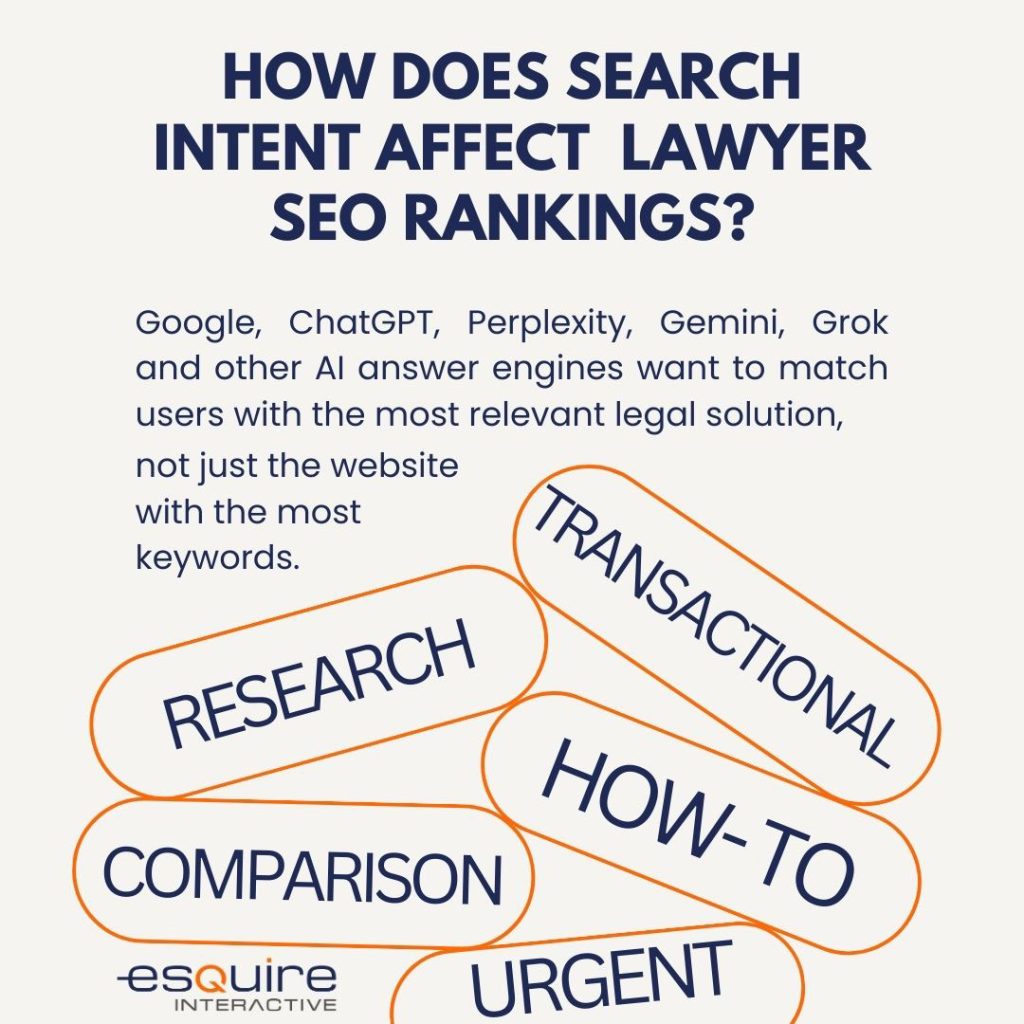
Search intent is one of the strongest signals in modern SEO for lawyers. Google, ChatGPT, Perplexity, Gemini, Grok and other AI answer engines want to match users with the most relevant legal solution, not just the website with the most keywords.
Urgent or Transactional Intent
Examples: “DUI lawyer tonight,” “emergency custody lawyer,” “injury lawyer near me.”
These users are ready to act. They need fast guidance and an immediate path forward. Pages targeting urgent intent must include:
- Clear descriptions of what the lawyer does
- Prominent contact buttons and mobile-first calls to action
- Fast-loading pages
- “What to do right now” instructions
- Local signals that confirm proximity and availability
AI systems heavily prioritize firms that demonstrate responsiveness, availability, and a clean entity profile for urgent queries.
Research Intent
Example: “How long do I have to file a lawsuit?”
These users want education, clarity, and reassurance. Content must be:
- Long-form and deeply informative
- Structured with FAQ schema and clear headings
- Factually precise and aligned with state law
- Written in a way that answers the question fully without oversimplifying
AI engines test whether your content satisfies the user’s informational need. Thin content harms visibility across all platforms.
Comparison Intent
Example: “Best divorce lawyer in Seattle,” “top criminal defense attorneys.”
These users are evaluating options. They need:
- Strong reviews with recent activity
- Reputation signals across the web
- High-authority directories and citations
- Case results and attorney credentials clearly displayed
- Cross-platform consistency so AI systems can verify your entity
Comparison-intent queries are increasingly handled by AI roundups that list firms based on authority, accuracy, and consistency, not self-proclaimed rankings.
Why Do Attorneys Lose Rankings When Search Intent Is Not Satisfied?
Attorneys lose rankings when their content fails to match what the user actually wants. Even well-written, detailed pages will underperform if they do not directly answer the intent behind the query. Modern search engines and AI platforms evaluate not only what a page says, but whether it fulfills the user’s next expected step.
If a user lands on a page and immediately leaves, scrolls only a small portion, refines their search, or clicks a competitor instead, Google interprets that behavior as a signal that the page did not satisfy the query. AI systems go even further, analyzing whether your content provides the right depth, structure, definitions, and clarity for the specific legal topic.
When intent is not met:
- Rankings decline
- Pages stop appearing in AI-generated answers
- Competitors with higher satisfaction signals take your place
Search intent is now one of the strongest drivers of visibility in law firm SEO. To outrank competing firms, your content must match not only the keywords but the user’s underlying purpose, urgency, and expectations.
What Can Attorneys Do to Stay Ahead of Intent-Based Search?
Attorneys must create content that satisfies each type of search intent while reinforcing entity authority across all platforms.
1. Align Content With Each Intent Type
Create distinct pages for urgent, informational, and comparison intent. A single page cannot satisfy all three. Attorneys should:
- Build urgent-response landing pages
- Publish deeper research articles with state-specific analysis
- Strengthen bio and reputation pages for comparison queries
This gives AI engines the right content for every kind of search.
2. Make It Easy for AI Systems to Understand Your Firm
Modern AI uses entity understanding, not just keywords. Attorneys should ensure:
- Consistent name, address, phone (NAP) across directories
- Robust attorney bios with full credentials
- Schema markup for attorneys, law firms, FAQs, and local business
- Accurate citations across legal directories and community sites
The clearer the entity, the more often AI systems surface it as a trusted answer.
3. Stay Active Everywhere Your Prospective Clients Search
Google is only one part of the picture. Attorneys who win in 2025 and beyond will maintain a presence in:
- AI platforms (ChatGPT, Perplexity, Gemini, etc.)
- Local directories and legal directories
- Reddit, Quora, and public-forum answers
- Press releases and media mentions
- High-authority backlink sources
Consistency across multiple environments strengthens your firm’s authority loop.
4. Update Content Frequently to Match Evolving Intent
User needs evolve, laws change, and AI systems adjust. Firms should:
- Refresh key pages every 6–12 months
- Expand top-performing articles
- Address emerging questions clients are asking in AI platforms
- Add new FAQs based on actual search behavior
Freshness is becoming a core ranking factor in AI-powered search.
5. Use Analytics to See Where Intent Is Failing
Attorneys can catch intent mismatches early by monitoring:
- Bounce rates and time on page
- Queries where the firm appears in AI search (FirmMetrics®, Ahrefs, Perplexity analytics)
- Which pages generate phone calls and message leads
- Where users drop off in the intake process
Intent optimization is measurable. Firms that evaluate performance regularly can adjust faster and outrank slower-moving competitors.
6. Work With Legal-Industry Specialists
Generic SEO agencies often misunderstand legal nuance, ethical constraints, and intent segmentation specific to legal search. Attorney-led marketing teams can:
- Identify intent trends before agencies detect them
- Write accurate, compliant content that satisfies AI engines
- Structure digital ecosystems that reinforce attorney authority
- Adapt quickly as search platforms evolve
This gives law firms a strategic advantage that is difficult for generalist marketers to replicate.
How Does AI Change the Way Lawyer SEO Works?
AI-driven search has transformed traditional lawyer SEO into a system where visibility depends on how well your firm can be understood, verified, and trusted across the entire digital ecosystem. Tools like Google’s AI Overviews, Bing Copilot, Gemini, Perplexity, and ChatGPT no longer rely on simple keyword matching. They analyze intent, extract facts, and evaluate credibility using large-scale language models.
When a user asks a legal question, AI platforms do not pull a single result. They launch a series of internal, intent-driven queries. These queries examine:
- Legal articles and guides
- Attorney directories
- Review platforms
- Bar association listings
- State statutes and government pages
- Media outlets
- Firm bios and practice-area content
The AI model then compares those sources, checks for consistency, evaluates jurisdictional accuracy, and determines which entities demonstrate real authority.
After gathering those signals, the AI system synthesizes a single answer for the user. In many cases, the user never clicks through to a website at all. This is why SEO for lawyers must extend far beyond traditional page optimization. AI engines reward firms that appear consistently and credibly across multiple platforms.
How AI Evaluates Law Firms
AI systems assess attorney websites and legal entities by determining:
- Whether attorney identities are verified across directories and bar listings
- Whether firm details are consistent across the web
- Whether legal explanations are accurate and jurisdictionally sound
- Whether content is structured with definitions, headings, and schema
- Whether attorneys publish or contribute to reputable sources
- Whether real lawyers are listed as authors or reviewers
These signals help AI identify which firms produce reliable legal information and which ones can be safely recommended to users.
Why AI Changes the Strategy Behind Law Firm SEO
Traditional SEO focused on optimizing individual pages. AI-driven SEO focuses on verifying the entity behind those pages.
AI wants to know:
- Who the firm is
- Whether the attorneys are real and qualified
- What practice areas the firm actually handles
- Where the firm operates
- Whether the firm’s information is trustworthy
This gives rise to Answer Engine Optimization (AEO), where the goal is not just to rank but to be recognized as the authoritative entity behind the answer.
What This Shift Means for Attorneys
To appear in AI-generated results, law firms must:
- Build a strong, unified digital identity
- Maintain consistent information across all platforms
- Produce legally accurate, structured content
- Strengthen external authority signals (directories, media, citations)
- Use schema markup that ties attorneys, services, and locations together
Firms that achieve this level of clarity and authority will be recommended by AI far more often. Firms that cannot be verified or appear inconsistently across sources will increasingly be excluded from AI answers, even if their website content is strong.
In the AI era, law firm SEO is no longer just about ranking pages. It is about earning recognition, confirmation, and trust at the entity level, across every place your firm appears online.
Why Does Entity Recognition Matter for Law Firm SEO?

Entity recognition is one of the most important factors in modern law firm SEO because it determines how search engines and AI platforms understand, categorize, and trust your firm. Instead of relying solely on keywords, systems like Google, ChatGPT, Perplexity, and Bing Copilot evaluate whether your firm exists as a clearly defined legal entity across the web.
To support strong SEO for lawyers, search engines must be able to confirm:
- Who your law firm is
- What legal services you provide
- Where you operate
- Which attorneys work at your firm
- Why you are a credible option for the user’s legal problem
What Search Engines Look for When Identifying an Attorney Entity
Key components of entity recognition for attorney SEO include:
- Official law firm name
- Attorney names and bar admissions
- Practice areas and legal niches
- Office locations and jurisdictions served
- Publications, speaking engagements, and media mentions
- Awards and recognitions
- Reviews and third-party citations
- Representative results when permitted
- Directory listings and bar profiles
These elements help search engines verify that your firm is legitimate, active, and consistently represented across the legal ecosystem.
Why Consistency Matters for Lawyer SEO
When your law firm appears under multiple variations of its name, address, practice areas, or attorney details, Google and AI systems may treat these as different or unverified entities. That uncertainty weakens authority signals and harms visibility in both traditional search and AI-generated answers.
A useful parallel:
If someone introduces themselves using three different names, you would question which version is real. Search engines react the same way when firm information is inconsistent.
Why Entity Recognition Is Essential in the AI Era
AI platforms prioritize firms they can verify. They do not just evaluate pages; they evaluate the stability and credibility of the organization behind the content. When a law firm maintains clear, unified entity signals across its website, directories, bar listings, and media sources, AI systems are far more likely to surface and recommend that firm.
For this reason, strong entity recognition has become a core pillar of SEO for law firms. Firms that maintain consistent, well-defined profiles gain more visibility across AI summaries and search results. Firms with fragmented or conflicting information lose trust and are often excluded from AI-driven answers entirely.
What Signals Help Law Firms Rank Higher in Search Results?
Law firm SEO ranking signals include:
Technical Signals:
- Fast loading speeds
- Mobile-friendly design
- Clean site structure
- Crawlable pages
- Secure hosting
Content Signals:
- Comprehensive practice pages
- Accurate legal explanations
- Long-form guides
- Clear headings and definitions
- FAQ sections
Local Signals:
- Reviews
- Google Business Profile optimization
- Local practice area pages
- Consistent address listings
Authority Signals:
- Backlinks from reputable sources
- Mentions in news or publications
- Directory listings
- Attorney credentials
Behavioral Signals:
- Time on page
- Low bounce rates
- Strong click-through rates
- Clear calls to action
Together, these signals help Google determine whether your law firm is the most relevant option for a specific legal query.
CHAPTER 3 — Keyword Research for Law Firms, Lawyers, and Attorneys
What Is Keyword Research and Why Is It the Foundation of Law Firm SEO?
Keyword research is the strategic process of identifying the search terms legal consumers use when looking for attorneys, legal answers, and next steps. For law firms, keyword research is the foundation of every SEO campaign because it determines the content you create, the pages you need, and the intent behind every search.
Legal consumers search differently from typical service-based industries. They often search during moments of stress or uncertainty, use legal terminology mixed with plain language, and rely on search engines to understand their rights before they ever consider contacting an attorney. Effective keyword research ensures your firm appears for all stages of this journey, from early education to immediate need.
Without keyword research, a law firm’s website is built on guesswork. With keyword research, every page has a purpose, every term is aligned with intent, and every content investment leads clients toward conversion.
How Do You Identify the Right Keywords for Law Firm SEO?
The right keywords depend on:
- Your practice areas
- Your geographic markets
- The competition in your jurisdiction
- The stage of the client’s search journey
- The complexity of the legal issue
- The types of cases you want to attract
Modern keyword research combines traditional SEO tools with AI-driven search behavior. Data is gathered from platforms such as Ahrefs, Semrush, Google Search Console, Google Keyword Planner, local SERP analysis, and now AI-platform analysis, which is rapidly becoming one of the strongest indicators of future search patterns.
A well-optimized strategy goes far beyond the obvious “money terms.”
For example, a personal injury firm in Dallas should not only target “personal injury lawyer Dallas TX,” but also hundreds of long-tail and question-based queries that real people use as they move through the research phase. These include searches about medical bills, settlement timelines, fault disputes, insurance tactics, and symptoms after a crash — all of which AI engines and Google use to determine the most helpful legal resource.
When selecting keywords, the goal is not simply volume. The winning formula is relevance + intent alignment + likelihood of converting into a case.
The firms that dominate search results understand how users think long before they ever decide to call a lawyer — and they build content that meets clients at every stage of that journey.
Why Does Search Intent Matter So Much for Lawyers and Attorneys?
Search intent describes why someone is searching, not just what they type. This is crucial for attorney SEO because Google’s top priority is matching users with the results that best fit their intention.
There are four primary intent types in legal SEO:
1. Hire-Now Intent (“Transactional Intent”)
The searcher is ready to hire an attorney.
Examples:
- “DUI lawyer near me”
- “car accident attorney Dallas”
- “divorce lawyer free consultation”
These keywords belong on practice area pages and location pages.
2. Information-Seeking Intent (“Research Intent”)
The searcher is trying to understand their situation.
Examples:
- “What happens after a hit-and-run in Texas?”
- “How is child custody determined?”
These belong in blogs, FAQs, resource hubs, and long-form guides.
3. Comparison Intent (“Commercial Intent”)
The searcher is evaluating options.
Examples:
- “best personal injury lawyer Dallas”
- “top employment lawyer near me”
Review velocity, authority signals, and Google Business optimization drive these rankings.
4. Navigational Intent
The searcher is looking for a specific firm.
Examples:
- “[Firm Name] reviews”
- “[Attorney Name] Dallas”
These searches are influenced by reputation and consistency across directories. If your content does not align with intent, Google and AI answer engines will not rank it, no matter how well written it is.
How Do Lawyers Build Keyword Clusters and Topic Groups?
Keyword clusters group related topics so you can build strong topical authority.
Instead of trying to rank with one page, you create an entire ecosystem of pages that reinforce each other.
Example: Personal Injury Cluster
Primary keyword: personal injury lawyer Dallas
Supporting pages might include:
- car accident lawyer Dallas
- truck accident attorney
- wrongful death lawyer
- slip and fall lawyer
- negligence elements in Texas
- statute of limitations Texas personal injury
- how insurance claims work in Texas
Together, these pages tell Google:
“This firm has deep expertise in injury law and all related subtopics.”
Example: Criminal Defense Cluster
Primary keyword: criminal defense attorney Austin
Supporting pages:
- DWI lawyer
- drug crime attorney
- domestic violence lawyer
- expungement process
- sentencing guidelines in Texas
Example: Family Law Cluster
Primary keyword: divorce lawyer Seattle
Supporting pages:
- child custody
- child support
- property division
- mediation vs litigation
- court timelines
Topic clusters create legal authority in the eyes of both Google and AI systems.
Why Are Long-Tail Keywords So Important for Lawyers?
Long-tail keywords are longer, more specific phrases that reflect deeper client needs.
Examples:
- “Can I sue Uber after a rideshare accident in Dallas?”
- “How do I get emergency custody in Colorado?”
- “What happens if I refuse a breathalyzer in Washington State?”
These keywords are extremely valuable because:
- They have clear search intent
- They convert at higher rates
- They attract more qualified clients
- They shape your content roadmap
- They build topical authority faster
Firms that dominate long-tail keywords often outperform much larger competitors.
Why Are Geo-Modified Keywords Essential for Law Firm SEO?
Nearly all legal searches include a geographic modifier.
Examples include:
- divorce lawyer Chicago
- criminal defense attorney Phoenix
- estate planning lawyer Miami
- business lawyer near me
- personal injury attorney Dallas TX
Geo-modified keywords are core to ranking in:
- Organic local search
- Google Business Profile
- AI local results
- Localized service pages
Each office location or service area needs its own dedicated landing page targeting these geo-modified terms.
How Do You Prioritize Keywords for Multi-Practice Law Firms?
Multi-practice law firms must prioritize keywords based on:
- Profitability of the practice area
- Competition levels in the market
- Demand volume
- Landing page needs
- Case value
- Business goals
For example, if personal injury is one of the most competitive areas in your market, your strategy will likely require a larger volume of content, deeper supporting resources, and stronger authority signals to break through the noise. On the other hand, if estate planning or probate has lower competition in your region, you may be able to achieve strong visibility with a smaller number of high-quality, thoroughly structured pages.
You can also consider which practice areas generate the most lucrative outcomes for your firm and prioritize those first. Areas that produce higher case values, stronger retainers, or more predictable revenue streams often warrant the greatest investment in content depth, entity building, and local authority. This ensures you allocate resources where they will deliver the highest financial return.
Prioritization ensures your SEO strategy aligns with real ROI, not just rankings. It helps you focus on the practice areas that matter most to your business while building long-term authority across your entire digital footprint.
FAQ’s About Keyword Research for Law Firms, Lawyers, and Attorneys
What keywords should a law firm focus on first?
Start with high-intent service keywords in your core practice areas and add geo-modified versions for your city.
Are informational keywords useful for attorneys?
Yes. Informational keywords build trust, attract early-stage clients, and strengthen topical authority.
How many keywords should a law firm target at once?
Dozens, not hundreds. Keywords should be organized into clusters with clear priorities.
Should each keyword have its own page?
Not always. Pages should align with intent, not just search volume.
How often should keyword research be updated?
Quarterly is ideal, especially for competitive practice areas.
CHAPTER 4 — Website Structure and Architecture for Law Firm SEO
What Is the Best Way to Structure a Law Firm Website for SEO?
A law firm website performs best when its structure is clear, organized, and aligned with how search engines evaluate legal information. Proper website architecture helps Google understand what your firm does, which practice areas you serve, and how each topic relates to the others. A well-structured site also improves usability for potential clients who may be feeling overwhelmed or stressed while searching for legal help. When your website is easy to navigate, clients stay longer, explore more pages, and are more likely to contact your firm. Search engines interpret these behaviors as strong trust signals.
Structuring a law firm website begins with organizing practice areas into clearly defined categories. This often takes the form of practice area silos, where each primary service has its own dedicated section. Within that section, you build out additional pages for the subtopics and case types that matter to your clients. For example, a personal injury silo may contain pages for car accidents, trucking accidents, wrongful death cases, slip and falls, and product liability matters. This structure tells search engines that your firm has depth and expertise in each practice area, which strengthens your ranking potential.
A strong structure also ensures your most important pages are only one or two clicks from the homepage. This improves crawlability, helps Google interpret priority, and prevents valuable content from being buried deep in the site. The goal is to create an architecture where both the search engine and the user can intuitively understand how your information is organized.
What Pages Does a Law Firm Need to Support Strong SEO?
A law firm website needs several key page types to compete effectively in modern search results. The homepage introduces your firm, establishes credibility, and guides visitors to your most important pages. Each primary practice area needs its own page that offers an in-depth explanation of what the service includes, who it helps, and what the legal process looks like. Subpractice pages provide even more detail about specific case types within each area of law.
Location pages help you rank in the cities, counties, and regions your firm serves. These pages combine geographic relevance with legal context, which is essential for local SEO. Attorney bio pages establish the expertise and trustworthiness of your lawyers. Search engines expect to see clear, accurate biographical information because legal websites fall under Google’s YMYL standards. Resource pages such as FAQs, educational blog content, and long-form guides help you earn visibility for informational searches and build topical authority.
Together, these pages create an ecosystem of content that mirrors how legal consumers search. Someone may begin with a general question, navigate to a subpractice page, and then read an attorney bio before contacting your firm. When your website includes all these elements, you create a complete journey for both users and search engines.
Why Does Website Architecture Influence Law Firm SEO Performance?
Website architecture influences how search engines interpret your expertise and authority. When your pages are grouped logically, link to each other in intuitive ways, and follow a clear hierarchy, Google can easily determine which content is most important and why. This structure reinforces topical authority, which is a major ranking factor for competitive practice areas.
For example, if your car accident page connects to trucking accidents, ride-share accidents, uninsured motorist claims, and wrongful death content, Google develops a clearer picture of your personal injury depth. When pages are isolated with no internal linking, search engines treat them as standalone entries without understanding their relationship to your broader body of work.
Strong architecture also prevents keyword cannibalization, which occurs when multiple pages unintentionally target the same keyword. Cannibalization confuses search engines and weakens your performance in competitive markets. A clean structure guides Google to the correct page for each topic and prevents dilution of ranking signals.
How Does Internal Linking Strengthen SEO for Lawyers?
Internal linking is a powerful but often overlooked element of lawyer SEO. Internal links help search engines understand the relationships between your pages and distribute authority throughout the site. By linking from broader pages to more detailed ones and vice versa, your website demonstrates depth and intentional structure.
For example, an estate planning page linking to wills, trusts, powers of attorney, probate, and guardianship content shows Google that these topics are closely related. A criminal defense page that links to DUI defense, domestic violence defense, drug crime representation, and sentencing guidelines reinforces your credibility within the criminal law silo.
Internal linking also improves user experience. When visitors find relevant links that answer their next question or explain the next legal step, they stay longer and engage more deeply with your content. Longer engagement sends positive signals to search engines, which can increase your rankings for related terms.
Why Does a Consistent URL Structure Matter in Attorney SEO?
A consistent URL structure helps both users and search engines understand the hierarchy of your pages. For law firms, this typically means structuring URLs around practice area categories and subtopics. A clear and predictable URL structure also improves crawlability, reduces confusion, and reinforces your topical authority.
Search engines rely on URL paths to understand how pages relate to each other. When URLs follow a logical system, Google can identify which pages belong to which practice area, which pages are primary, and which pages support deeper topics. This consistency becomes especially valuable for firms with multiple locations or highly segmented practice areas.
The following is an example of a good URL versus a bad URL for a personal injury practice area:
Good URL structure:
www.examplelawfirm.com/personal-injury/car-accident-lawyer/
This is clean, predictable, and clearly shows the hierarchy. Google can immediately understand that “car accidents” is a subtopic of “personal injury.”
Bad URL structure:
www.examplelawfirm.com/page?id=472&ref=injury2024
This is unclear, provides no topical context, and gives Google no indication of how the page fits within the site’s structure. It also makes it harder for users to trust the link or navigate back to related topics.
Clean, descriptive URLs help search engines understand your intent and help users understand exactly where they are on your site.
How Should Calls to Action Be Integrated Into a Law Firm Website?
Calls to action are part of your website’s conversion architecture. Every high-value page should guide users toward the next step, whether that is contacting the firm, scheduling a consultation, submitting a case evaluation, or calling directly. Because legal consumers often arrive with heightened emotion or urgency, your calls to action must be clear, visible, and easy to use.
Strong calls to action reduce friction, increase conversions, and improve user satisfaction. Search engines observe user behavior, and websites that retain visitors and convert them efficiently tend to perform better in search results over time. CTA placement is not just a marketing strategy; it is a component of your overall SEO performance.
FAQ: Website Structure and Architecture for Law Firm SEO
How many pages does a law firm website need to rank well?
Most firms need a homepage, detailed practice area pages, subpractice pages, attorney bios, location pages, and educational content. Highly competitive markets may require dozens of supporting pages.
Should every legal service have its own page?
Yes. Dedicated pages help target specific keywords and provide depth of content that search engines expect in authoritative legal websites.
Does URL structure affect SEO for lawyers?
Absolutely. Clean, consistent, and organized URLs help search engines understand your site’s hierarchy and improve overall crawlability. A properly structured URL signals what the page is about, how it relates to the rest of the site, and which location or practice area it belongs to.
We frequently identify URL structure as a major impediment on law firm websites. Many firms unintentionally create confusion by mixing multiple geographic locations or practice areas inside a single URL. For example, a page might appear as:
- /personal-injury/seattle-bellevue-tacoma/car-accidents/
Or
- /family-law/divorce/portland-vancouver/child-custody/
While this may feel thorough from a human perspective, it sends conflicting signals to Google. Search engines cannot determine which location the page is meant to rank for, what the primary topic is, or how the content should be categorized. Inconsistent or overly complex URLs dilute relevance, weaken local SEO signals, and make it harder for AI systems to map the entity relationship between your practice areas and your service locations.
A clean URL structure should reflect:
- A single practice area
- A single geographic target
- A clear hierarchy (e.g., /practice-area/location/topic/)
- A predictable pattern repeated across the entire site
When your URLs reinforce a logical architecture, Google can understand your content more easily, rank it more accurately, and trust it more consistently, all of which are essential for law firm SEO in both traditional and AI-driven search.
How does internal linking help attorney SEO?
Internal links show relationships between topics, help Google and AI answer engines understand your authority, and guide users toward key pages that convert.
CHAPTER 5 — Content Strategy for Law Firms, Lawyers, and Attorneys
Why Is Content Strategy Essential for Law Firm SEO?
Content is the engine that drives law firm SEO because it answers the questions legal consumers ask and signals authority to search engines. People who need legal help turn to Google at every stage of their journey, from identifying their problem to evaluating attorneys. When your website contains well-structured, attorney-written content, your firm becomes the trusted source that guides them toward hiring you.
Search engines reward firms that provide depth, accuracy, and clarity, especially because legal topics fall under Google’s highest scrutiny standards. Law firms with strong content strategies consistently outperform those that rely on thin, generic pages or outdated blogging approaches (i.e., adding hundreds, or even thousands, of keyword-stuffed blog posts to a site).
Content strategy is more than producing individual articles or pages. It is a long-term plan that intentionally builds topical authority. This means covering every important question, subtopic, and legal concept within a practice area. It means not only explaining what you do, but demonstrating expertise through analysis, legal context, examples, and guidance.
When your content anticipates user needs, search engines view your firm as a comprehensive resource that deserves visibility across multiple keywords.
What Types of Content Does a Law Firm Need to Compete in Search Results?
A law firm must publish several types of content to build authority across traditional search engines and AI-driven platforms.
- Practice area pages remain the backbone of SEO because they target high-intent keywords from people ready to hire an attorney. These pages must be detailed, locally relevant, and written in clear, accessible language.
- Subpractice pages support these primary pages by drilling deeper into specific case types, legal issues, or procedural topics. They help capture long-tail keywords and strengthen topical coverage.
- Attorney bio pages play a crucial role as well. Search engines evaluate expertise and trust using signals such as credentials, bar admissions, education, representative matters, publications, and professional experience. Detailed biographies help both users and search engines understand who will be handling the case and why that attorney is qualified.
- Long-form guides and educational resources give your firm visibility for research-based queries, which often precede attorney hiring decisions. These guides can cover topics such as timelines, legal processes, evidence, damages, sentencing factors, or state-specific rules.
- Blog posts, FAQs, and resource libraries fill in the remaining gaps. They answer the specific, question-based searches people make before they even realize they may need legal representation. These content types are especially valuable in AI search, where answers are extracted and synthesized from high-quality resources.
How Should a Law Firm Develop Its Content Roadmap?
A content roadmap outlines which pages your firm needs, the order in which they should be created, and how they connect to each other. This roadmap is built around practice area priorities, competitive analysis, keyword research, and client needs. The starting point is documenting the core services your firm offers and creating robust pages for each one. These serve as the foundation for your topical clusters.
After the main service pages are established, the roadmap expands into supporting topics. These include procedural guides, explanations of legal terminology, FAQs, and detailed pages for specific case types. The goal is to ensure that anyone searching for information related to your practice area can find an answer on your site. In highly competitive markets, this depth is not optional. It is the barrier to entry.
A successful roadmap also accounts for state-specific statutes, deadlines, legal standards, and procedural differences. Search engines reward localized and jurisdictionally accurate content because legal requirements vary. The more aligned your content is with your state’s laws, the more trustworthy it appears to both users and search engines.
Why Must All Law Firm Content Be Written With Search Intent in Mind?
Even the best-written legal content will not rank if it does not align with the intent behind the user’s query. Search intent determines the purpose of the search, and law firms must match that purpose with the appropriate content format. High-intent searches require detailed service pages that clearly outline what the firm does and how to get help. Research-based queries require educational content that provides context, guidance, and next steps without immediately pushing for a consultation.
Some searches require an authoritative explanation of legal processes, while others require reassurance or clarity about rights and obligations. Understanding intent ensures your content meets the user where they are in the decision-making process. This alignment increases engagement, reduces bounce rates, and strengthens your overall SEO performance.
How Important Is Legal Accuracy and Attorney Review in Law Firm Content?
Legal content must be accurate, current, and reviewed by attorneys. Because the legal industry is classified under Google’s “Your Money, Your Life” standards, search engines scrutinize content more heavily than in most other industries. Inaccurate or misleading content can harm users, and Google penalizes websites that lack the expertise required to discuss legal topics responsibly.
For this reason, attorney-written content or attorney-reviewed content is essential. Your content should reflect your understanding of state-specific laws, statutes, procedures, and case outcomes. When attorneys write or review the material, it resonates with legal accuracy that AI platforms and search engines can detect. This improves your credibility and ranking potential while reducing ethical risks.
At Esquire Interactive, all legal content is created by a team of four in-house attorney writers who understand both the substance of the law and the standards search engines apply to YMYL content. Because they are trained lawyers, they write with precision, incorporate jurisdiction-specific requirements, and ensure every page meets the level of authority and clarity that both Google and AI systems expect from legal publishers. This attorney-led approach eliminates guesswork, reduces risk, and ensures content reflects real legal experience rather than surface-level summaries.
If you need assistance writing your law firm content, please contact us at 520-261-8645 to schedule a free consultation.
Why Does Topical Authority Matter So Much for Lawyers?
Topical authority refers to how comprehensively your firm covers a subject. In law firm SEO, topical authority is one of the strongest predictors of ranking success. Search engines do not simply rank individual pages; they evaluate the entire body of related content on your site. If you have one page about car accidents but no pages on trucking accidents, motorcycle accidents, wrongful death, insurance disputes, or negligence elements, Google will not see you as an authoritative personal injury resource.
Topical authority is built progressively by developing interconnected content around a single legal concept. The more depth you add over time, the more trust your site earns. Competing firms may have fewer or shorter pages, but if your site covers the full subject matter more thoroughly, you gain a competitive advantage that is difficult to reverse.
How Does Long-Form Content Strengthen SEO for Attorneys?
Long-form content shows both users and search engines that your firm has a deeper understanding of the topic. Complex legal issues often require detailed explanations, context, and scenario-based guidance. Long-form content also encourages users to spend more time on the page, which sends positive engagement signals.
Search engines increasingly prefer long-form pages for legal queries because they provide comprehensive coverage. Short, surface-level content rarely performs well in competitive markets. A well-crafted long-form guide can rank for dozens or even hundreds of long-tail keywords at once, making it an efficient and powerful investment.
How Does Content Support AI Search and New Answer Engines?
AI platforms extract, evaluate, and summarize content from across the web. Unlike traditional search, AI systems rely heavily on structured information, clear definitions, question-based content, and signals that confirm your authority across multiple sources. When your content answers common legal questions, clearly defines key concepts, and reflects attorney-level accuracy, AI systems are more likely to quote or summarize your pages.
Question-based FAQs, structured paragraphs, jurisdictional explanations, and well-defined legal processes are essential for AI search visibility. These elements increase the likelihood that your content will be surfaced in AI-generated answers and overviews.
FAQ: Content Strategy for Law Firms, Lawyers, and Attorneys
How often should law firms publish new content?
Firms in competitive markets should publish consistently. Weekly content helps maintain visibility and topical depth.
Is long-form content better than short-form content for SEO?
Yes. Long-form content typically performs better because it provides comprehensive answers and captures more search intent variations.
Do attorneys need to write their own content?
No, but they should always review the work product before it is published to ensure accuracy and compliance with the ethics rules. If possible, content should always be attorney-written to ensure accuracy, trustworthiness, and compliance with Google’s standards.
Should blogs still be part of a law firm content strategy?
Yes, but only when used strategically. Blogs should address specific questions, legal updates, or procedural explanations, not generic topics.
CHAPTER 6 — Local SEO for Law Firms, Lawyers, and Attorneys
Why Is Local SEO Essential for Lawyers and Law Firms?
Local SEO is one of the most important components of law firm marketing because almost every legal search includes a geographic element. Legal consumers typically look for attorneys close to where they live, work, or where the legal issue occurred. When someone searches for a term like “criminal defense attorney near me” or “personal injury lawyer in Dallas,” Google prioritizes results based on proximity, relevance, and credibility. This means that even if a firm has an excellent website, it may not appear in local search results unless it has a strong local SEO strategy.
Local SEO ensures that your law firm shows up in your community’s searches, maps, and AI-driven recommendations. When a prospective client performs a local search, they are often ready to act immediately. If your firm appears prominently in the map pack, local results, and localized organic rankings, you are positioned to capture high-intent leads at precisely the right moment. Firms that invest in local SEO consistently outperform competitors who rely solely on traditional organic rankings.
What Signals Does Google Use to Rank Law Firms in Local Search?
Local rankings are influenced by several key factors that, again, collectively demonstrate your firm’s presence, reputation, and trustworthiness within a specific geographic area. Google and AI answer engines evaluate these signals to determine which attorneys should appear in local search results.
The signals include:
- Google Business Profile strength,
- local citations,
- NAP consistency,
- location relevance,
- reviews and ratings,
- website location signals,
- behavioral engagement, and
- authority across legal directories.
Each of these elements plays a role in how search and answer engines validate a firm’s location, verify your professional identity, and measure whether you are a reliable option for local users.
How Should Law Firms Optimize Their Google Business Profile?
Your Google Business Profile is one of the most influential assets in local SEO. It determines whether your firm appears in the map pack, local finder, and localized organic search results. A well-optimized profile significantly increases your visibility for high-intent legal searches, especially on mobile where map results occupy the most prominent screen space.
Law firms should complete and optimize all sections of their profile. Important elements include:
- accurate business names,
- the correct primary and secondary categories,
- keyword optimized service offerings,
- location information,
- service areas,
- office hours,
- descriptions,
- social media links,
- photos, and
- appointments or consultation links.
Posting updates and adding questions and answers can further strengthen your profile by signaling ongoing activity and engagement.
One of the strongest signals within your profile is your review velocity. Prospective clients rely heavily on reviews when evaluating attorneys, and Google uses review quality, quantity, and recency to determine your local ranking. Firms with consistent, positive review growth perform better in both the map pack and AI-generated recommendations.
Why Does NAP Consistency Matter for Lawyers?
NAP stands for name, address, and phone number. Google expects this information to be identical everywhere your firm appears online. Any inconsistency across directories, bar listings, social profiles, or citations can cause ranking issues because it creates uncertainty about your firm’s identity.
For example, if your website uses “The Law Offices of Smith & Green, PLLC,” but your Google Business Profile uses “Smith and Green Law,” Google may interpret these as separate entities. This weakens your authority, reduces trust, and harms local visibility. Maintaining consistent information across all platforms strengthens your local SEO and improves your firm’s ability to appear in geographically targeted searches.
To help maintain this consistency across the web, many firms use directory management platforms such as BrightLocal and Yext. These services push your firm’s name, address, and phone number to dozens or even hundreds of directories at once, ensuring uniform information across the entire citation ecosystem. While manual updates are possible, they are often time-intensive and error-prone, especially for firms with multiple locations or attorneys. Directory builders centralize the process, reduce the risk of outdated listings, and reinforce the strong NAP signals that Google relies on to validate your firm’s identity.
What Role Do Local Citations and Directories Play in attorney SEO?
Local citations validate your firm’s legitimacy. They serve as external trust signals that confirm your business name, location, and contact information. While citations used to be a primary ranking factor, they are now one of several supporting signals. However, they remain essential for law firms because legal websites fall under a high-trust classification.
If your firm operates in multiple cities or counties, citations become even more important. Google evaluates citations to determine whether each office location is legitimate and active. Citations also help AI search engines identify your firm across the web and tie your digital presence together through entity recognition.
Important citation and directory sources for attorneys include:
- Justia,
- Avvo,
- FindLaw,
- com,
- Martindale,
- Nolo,
- Yelp,
- BBB,
- Bing Places, and
- Apple Maps.
Local directories within your city or county can also strengthen your relevance for geographically targeted searches.
How Should Law Firms Use Location Pages to Improve Local Rankings?
Location pages help law firms target specific cities, counties, and regions. These pages are essential because Google prefers to show localized content when someone includes a city or uses “near me” phrasing. A strong location page includes:
- locally relevant content,
- the office’s address,
- case types handled in that region,
- maps and driving directions,
- unique legal considerations for that jurisdiction, and
- locally relevant FAQs.
The biggest mistake law firms make is recycling the same content across multiple location pages. Every page must be unique. When your content includes city-specific references, jurisdictional details, and tailored examples, it strengthens local authority and supports both organic and map-based rankings.
Why Are Reviews So Important for Local SEO and Client Trust?
Reviews are one of the strongest ranking factors for local SEO, and they are also one of the most important conversion factors for potential clients. People rely on reviews to evaluate experience, professionalism, communication, outcomes, and overall trust. Google measures not just the number of reviews, but the recency, frequency, diversity, and quality of those reviews.
Search engines treat reviews as real-world evidence of your firm’s authority and client satisfaction. Firms with consistent review growth outperform competitors who only receive occasional or outdated feedback. Review content also influences AI platforms, which often cite or summarize review sentiment in their recommendations.
A dedicated review strategy helps law firms maintain a strong local presence. This includes guiding clients toward platforms that matter, monitoring feedback, and creating ethical, compliant processes to request reviews. Your goal is to build credible, consistent signals that reinforce your firm’s reputation.
How Can Law Firms Streamline Review Management?
Consistently generating reviews can be one of the most time-consuming parts of local SEO, especially for firms with a high client volume. While manually requesting reviews is possible, it is rarely sustainable. Most firms simply do not have the time to send individual invitations or follow up regularly, which leads to inconsistent review growth and weaker local visibility.
To solve this, we recommend using a dedicated review management system such as . This platform allows firms to send mass review invitations with a single click, automate follow-up reminders, and manage all platforms from one dashboard.
Instead of relying on sporadic outreach, FirmReviews® creates a steady and predictable review pipeline that signals trust, activity, and client satisfaction to both Google and AI systems. This approach helps firms stay ahead without increasing administrative workload and ensures that review velocity remains strong over time.
How Do Local Landing Pages Support Multi-City or Multi-Office Law Firms?
Firms with multiple office locations must develop a tailored local SEO strategy for each location. Google treats each office as a separate entity, which means each one must have its own:
- Google Business Profile,
- unique location landing page,
- localized content, and
- supporting citations.
Multi-location firms often face challenges with content duplication and NAP inconsistency. To avoid these pitfalls, each location page should include original text, local references, different testimonials, and jurisdiction-specific information. This approach helps Google understand that each office serves a distinct geographic area and deserves its own placement in local results.
Developing a cluster around each location strengthens both local and organic rankings. This cluster can include supporting pages for local practice areas, localized blogs, and region-specific FAQs.
For example, if your firm has an office in Denver, your location cluster might include a main Denver Personal Injury Lawyer page, followed by supporting pages such as Denver Car Accident Lawyer, Denver Truck Accident Lawyer, Denver Slip and Fall Lawyer, and Denver Wrongful Death Lawyer. You could then add localized blog topics like “What to Do After a Car Accident in Denver” or “How Colorado’s Comparative Negligence Law Works in Denver Injury Cases,” along with region-specific FAQs addressing local courts, insurance practices, or filing deadlines. This type of structured cluster tells Google that your firm is deeply relevant to both the location and the legal topics clients are searching for.
FAQ: Local SEO for Lawyers and Law Firms
How long does local SEO take for law firms?
Most firms begin seeing improvement within three to four months, with stronger performance developing over six to twelve months depending on the competition.
Can a law firm rank in more than one city?
Yes. With dedicated location pages, individual office profiles, and proper NAP management, law firms can rank in multiple cities or counties.
Do reviews impact local rankings for attorneys?
They do. Google evaluates the quality, frequency, and velocity of your reviews when determining your placement in the map pack.
Is a Google Business Profile required for local SEO?
Absolutely. Without a complete and optimized Google Business Profile (GBP), it is extremely difficult for a law firm to appear in local search results or in the map pack. For most practice areas, especially personal injury, criminal defense, family law, and immigration, Google treats GBP as a core trust signal.
A strong profile includes accurate NAP information, correct practice categories, business hours, a compelling description, photos, and consistent citations across the web.
Maintaining the profile is just as important as setting it up. Google evaluates activity and freshness to determine whether a business is active in the community. Law firms that update their profile weekly tend to outperform those that leave it untouched.
Weekly updates can include posting a short update or FAQ, adding photos or videos, responding to reviews, adjusting hours, or adding new services. These small actions indicate credibility and relevance, which helps you remain visible in both local search and AI-driven results.
A regularly updated Google Business Profile is essential for staying competitive in modern local SEO.
CHAPTER 7 — On-Page SEO for Lawyers and Law Firms
What Is On-Page SEO and Why Does It Matter for Law Firms?
On-page SEO is the process of optimizing the individual pages of your law firm website so search engines can understand what each page is about and why it deserves to rank. While technical SEO focuses on the performance of the site as a whole, on-page SEO focuses on the content, structure, and elements that appear directly on the page. Because legal queries fall under Google’s highest trust and accuracy standards, on-page optimization is essential for demonstrating expertise, relevance, and authority.
For law firms, effective on-page SEO makes the difference between ranking on page one for high-value legal keywords or being buried under firms with clearer, more strategically optimized content. A well-optimized page helps Google understand your practice area, your jurisdiction, your attorney qualifications, and the legal issues you handle. It also helps users find the information they need quickly, which builds trust and increases the likelihood that they will contact your firm.
What Elements of a Page Does Google Use to Understand Attorney Expertise?
Google evaluates several page-level signals to determine whether a page is authoritative, relevant, and trustworthy enough to rank highly for legal terms. These include:
- title tags,
- meta descriptions,
- header structure,
- keyword placement,
- internal links,
- external links,
- author information, and
- supporting legal context.
Each of these elements helps Google understand what the page covers and whether the content demonstrates the expertise required to address legal matters responsibly.
Law firms benefit from on-page SEO because it allows you to highlight attorney credentials, explain legal processes, and provide accurate, jurisdiction-specific information. When these signals are consistent across your site, your firm becomes a stronger candidate for competitive rankings and AI-assisted search visibility.
How Should a Law Firm Use Title Tags and Meta Descriptions to Improve Rankings?
Title tags and meta descriptions are often the first elements both users and search engines see. The title tag must clearly communicate the topic of the page and include the primary keyword. For lawyers, this typically means including the practice area and the geographic location. Search intent should drive your title tag, ensuring it reflects what the user is likely to search.
Meta descriptions do not directly influence rankings, but they strongly influence click-through rates. The meta description should provide a compelling, concise summary of the page while incorporating important terms like your practice area, city, and a clear value proposition. When your metadata matches user intent, you increase engagement, which sends positive behavioral signals to Google.

Why Are Header Tags Important for Law Firm SEO?
Header tags give structure to a page and help search engines understand the hierarchy of information. For law firms, they organize explanations of statutes, legal processes, rights, timelines, and case types in a way that both users and search engines can follow. When headers are phrased as the natural questions clients ask, the page aligns with traditional search and AI-generated answers.
We often see attorneys try to create visual hierarchy by simply increasing font sizes or changing font styles. This does not help SEO. Headers must be actual HTML heading tags so Google can interpret the meaning and importance of each section.
Every page should have:
- One H1 tag for the main title
- Multiple H2 tags for primary sections
- H3 and H4 tags for supporting subtopics
This structure should mirror how a client would naturally explore the legal issue. A clear heading hierarchy improves readability, increases engagement, and strengthens on-page SEO because search engines can quickly understand what each section covers.
A properly structured page is easier for users to scan and easier for AI systems to classify, which leads to improved visibility across all search formats.
How Should Lawyers Use Keywords Within Page Content?
Keyword usage should feel natural, authoritative, and helpful. Lawyers should use primary keywords in the opening paragraph, at least one header, the body content, image alt text, and the closing section. Secondary and related keywords should be included in contextually relevant sentences, not forced or repeated excessively.
For example, a personal injury attorney page should include references to car accidents, negligence, insurance disputes, injuries, damages, and jurisdiction-specific standards.
Search engines evaluate the breadth and depth of your keyword usage to determine whether your page thoroughly addresses the topic. Balanced, well-integrated keywords help establish topical authority. Conversely, pages that are unnaturally stuffed with too many high-value keywords can also be viewed as spam, resulting in the pages being demoted in the rankings.
How Do Internal Links Improve On-Page SEO for Lawyers?
Internal links guide users to related content, reinforce authority, and help Google and AI answer engines understand how topics connect across your site. Instead of isolating pages, internal links create a structured network of information. For instance, a family law overview page should connect to supporting pages such as divorce, child custody, child support, property division, and mediation. These link pathways signal to search engines that your firm offers comprehensive coverage of the practice area and that each topic is supported by deeper, authoritative content.
Internal linking is especially important for law firms because legal topics tend to be multi-layered and interdependent. Establishing clear relationships between your pages strengthens your topical hierarchy and improves the visibility of your most important practice areas.
Why Should Law Firm Pages Include Outbound Links to Authoritative Sources?
Outbound links help demonstrate credibility by referencing legal statutes, court decisions, state regulations, or official procedural information. When used appropriately, they signal that your firm’s content is accurate and grounded in legitimate legal authority. Examples include linking to:
- state statutes,
- court websites, or
- official government resources.
This practice not only improves user trust but also helps search engines confirm that your content meets the high standards required for YMYL pages.
How Should Law Firms Optimize Images and Multimedia for SEO?
Images and multimedia play a significant role in how users engage with legal content. Attorney photos, courtroom diagrams, statute flowcharts, explainer graphics, and infographics can all help clarify complex legal topics and increase the time visitors spend on a page. However, visuals must be properly optimized or they can slow down your site, confuse search engines, or fail to contribute to your topical authority.
Search engines rely on file names, alt text, and contextual placement to understand what an image represents. This is especially important on legal websites, where accuracy and clarity are critical. Alt text allows Google, AI systems, and screen readers to interpret the image’s subject matter. When alt text is descriptive and aligned with the content of the page, the image strengthens the page’s relevance and improves accessibility for users with visual impairments.
Image optimization for law firms should include several key steps. Use descriptive file names instead of default ones, such as “john-doe-criminal-defense-attorney.jpg” instead of “IMG_2044.jpg.” Include alt text that explains the image and incorporates relevant search terms where appropriate, such as “photo of a family law attorney meeting with a client about child custody.” Compress image sizes to reduce load times without sacrificing quality, which helps improve Core Web Vitals. Place visuals strategically within the content so they support the surrounding text and help guide readers through the page.
Multimedia elements such as videos, embedded charts, and PDF guides should also be optimized. Videos need transcriptions or captions, as search engines use this text to evaluate relevance. Embedded documents should have descriptive titles and metadata.
All multimedia should support the page’s overall topic rather than distract from it. When optimized correctly, images and multimedia do more than enhance a page visually. They contribute to the page’s authority, improve user engagement, support accessibility requirements, and help AI-driven systems better understand the context and intent of your content.
Why Does Readability Matter for On-Page SEO in Legal Content?
Legal topics are often confusing, stressful, or unfamiliar to clients. Clear, plain-language writing increases readability, engagement, and comprehension. Readability also affects SEO performance. Search engines evaluate how long users stay on the page, how far they scroll, and whether they return to the search results.
When content is overly dense or filled with legal jargon, users leave quickly. When content explains complex topics in accessible language, users stay longer and engage more deeply. Consequently, readability directly influences behavioral ranking signals that benefit your site.
How Should Law Firms Structure Their Calls to Action to Improve Conversion?
Calls to action must be clear, visible, and aligned with the client’s likely next step. High-intent users should always see a clear path to contact the firm. Strong calls to action include:
- phone numbers,
- consultation forms,
- click-to-call buttons,
- linked office locations, and
- next-step instructions.
Calls to action should appear at the top of the page, within the content, and again at the bottom. These repeated touchpoints ensure that potential clients can take action at any moment of their decision process, whether they are urgently seeking help or still evaluating their options.
A well-timed popup can also capture attention, especially when a user appears ready to leave the page or has scrolled through a significant portion of the content. When executed thoughtfully, a popup can convert hesitant users by offering a clear prompt such as scheduling a free consultation or calling for immediate help. Proper timing, relevance, and simplicity make these popups powerful tools for improving conversions without disrupting the user experience.
Strategically placed calls to action help guide visitors smoothly from research to contact, which strengthens both user engagement and overall SEO performance.
FAQ: On-Page SEO for Lawyers
What is the most important on-page element for law firm SEO?
The title tag is one of the most important elements because it determines whether your page is relevant for the query and influences click-through rates.
How often should law firms update on-page SEO?
Pages should be reviewed quarterly, especially in competitive markets or when laws change.
Do attorneys need to use keywords in every header?
Not necessarily. Headers should focus on clarity and user intent, with keywords appearing naturally where appropriate.
Are long pages always better for SEO?
Long pages perform well when they are comprehensive and helpful. However, thin content or filler text does not improve rankings.
CHAPTER 8 — Technical SEO for Lawyers and Law Firms
What Is Technical SEO and Why Is It Critical for Law Firm Websites?
Technical SEO refers to the behind-the-scenes elements that allow search engines to crawl, interpret, and index your website. While content determines what you say and why clients should trust you, technical SEO determines whether Google can access your content at all. Google evaluates law firm websites for errors, slow load times, security issues, broken links, and user-experience problems.
A law firm with strong content can still struggle to rank if its technical foundation is weak. A slow site, broken architecture, or crawl errors can prevent high-value practice pages from being indexed. Technical SEO ensures search engines can navigate your site cleanly, understand your structure, evaluate your authority, and deliver your pages to users who need legal help. It is the silent engine that powers ranking potential across every practice area.
How Does Website Speed Affect SEO for Lawyers?
Speed is one of the strongest technical ranking factors because it directly impacts user experience. Legal consumers often search during stressful or urgent situations. If a page takes too long to load, they leave quickly and choose another firm. Google tracks these behaviors, and sites with slow performance suffer lower rankings, reduced map visibility, and poor conversion rates.
Improving speed often requires optimizing several components. These include:
- image compression,
- efficient hosting,
- content delivery networks,
- minified code,
- reduced scripts, and
- clean site architecture.
When these elements are properly tuned, pages load quickly on both desktop and mobile devices. Faster websites retain more traffic, improve engagement, and generate stronger SEO signals. In competitive practice areas, even small improvements in page speed can influence rankings.
Why Is Mobile Optimization Essential for Law Firm SEO?
Most legal searches now come from mobile devices. People use their phones to search for lawyers when accidents happen, when they are pulled over, when family disputes arise, or when they have urgent legal questions. Because legal queries are often time-sensitive, users expect a seamless mobile experience.
Google uses mobile-first indexing, meaning the mobile version of your site is the primary version evaluated for rankings. If your site is difficult to use on mobile, whether due to small text, misplaced buttons, slow loading, or confusing menus, Google reduces your visibility. Mobile-optimized law firm sites include:
- readable typography,
- touch-friendly buttons,
- simplified navigation,
- fast mobile loading, and
- clear calls to action.
When users can find answers and contact you easily from their phones, search performance improves across the board.
How Does Site Architecture Affect Crawlability and Indexing?
Search engines discover your pages by crawling them. A clean, organized architecture ensures crawlers can navigate your website without hitting dead ends or confusing structures. When pages are buried too deeply, use inconsistent URLs, or are disconnected from internal links, crawlers may fail to reach them. This can cause important practice area pages to remain unindexed.
To improve crawlability, law firms must structure their sites logically. This includes:
- clean URL paths,
- organized practice area silos,
- internal links between related pages,
- a simple navigation menu, and
- indexation rules that match your SEO strategy.
A well-structured site helps Google and AI systems understand your practice, your relationships between topics, and your overall authority.
How Do Indexation Rules Impact Law Firm SEO?
Indexation determines which pages Google chooses to include in its search index, and therefore which pages are even capable of ranking. Many law firms assume that more indexed pages equal better SEO. In reality, the opposite is often true. When Google indexes low-quality or unnecessary pages, it spreads your site’s authority thin and makes it harder for your most important content to rank.
Common problems we see on law firm websites include:
- Duplicate or near-duplicate pages created during redesigns
- Thin attorney bio pages with little meaningful content
- Outdated announcements and press releases
- Auto-generated tag or category archives with no strategic value
- Empty practice area pages created “just in case”
- Multiple URLs targeting the same keyword, causing keyword cannibalization
When Google spends crawl budget on these irrelevant or redundant pages, it may overlook the pages that actually drive leads, such as your primary practice area pages, service-area pages, and key educational guides. Poor indexation control leads to weaker visibility, slower ranking improvements, and confusion in how Google interprets your site.
Law firms must set clear indexation rules to avoid these problems. This is done using:
Robots.txt
Controls which sections of the site Google is allowed to crawl.
Meta robots tags
Tell Google whether a page should be indexed or followed.
Canonical tags
Identify the primary version of a page when similar variations exist. This is critical for law firms because many practice pages naturally overlap in topic. Canonicals ensure Google attributes authority to the correct URL instead of splitting it across duplicates.
Proper indexation is one of the most overlooked components of technical SEO in the legal industry. When handled correctly, it:
- Strengthens your highest-value pages
- Eliminates keyword cannibalization
- Improves crawl efficiency
- Reduces noise in Google’s understanding of your site
- Helps AI systems surface the right page for the right query
Indexation strategy is ultimately about focus. By telling these search and answer engines exactly which pages matter and which do not, you protect your authority and give your best content the opportunity to rank competitively in both traditional and AI-driven search results.
Why Is Security Important for Law Firm Websites and Rankings?
Security is a core requirement for legal websites. Clients trust attorneys with highly sensitive information, and search engines treat insecure websites as high-risk. An insecure or improperly configured SSL certificate can reduce rankings, block indexing, and cause browsers to warn users that your site is unsafe.
A secure law firm website includes:
- a valid SSL certificate,
- up-to-date hosting,
- strong encryption,
- secure forms, and
- clean code with no injection vulnerabilities.
These measures build trust with both users and search engines. Because legal matters often involve personal or financial information, Google expects attorney websites to exceed basic security standards.
How Do Sitemaps and Robots Files Support Technical SEO?
Sitemaps and robots files act as communication tools between your site and search engines. A sitemap provides Google with a list of your important pages, helping crawlers locate content more efficiently. A well-built sitemap includes:
- practice area pages,
- subpractice pages,
- location pages,
- bios, and
- resource content.
The robots.txt file tells crawlers which areas of your site they should or should not access. This prevents search engines from wasting crawl budget on irrelevant directories or duplicate content. Together, sitemaps and robots instructions help guide Google’s understanding of your website structure and ensure efficient indexing.
Why Do Broken Links and Redirect Chains Harm Law Firm SEO?
Broken links create user frustration and signal poor site maintenance. Redirect chains slow download times and confuse search engines. Both issues harm your crawlability, engagement signals, and ranking potential.
Law firms must regularly check for 404 pages, redirect loops, internal links pointing to outdated URLs, and orphaned pages. Fixing these issues strengthens site authority and improves the flow of traffic through your content. Clean internal structure also helps AI systems understand the relationships between topics and attorneys.
How Should Law Firms Optimize Core Web Vitals?
Core Web Vitals are a set of performance metrics Google uses to evaluate how users experience your website. These metrics focus on how quickly a page loads, how stable it is while loading, and how responsive it feels when users interact with it. Because legal consumers often visit websites in moments of urgency or stress, poor performance can lead to immediate abandonment. Google also incorporates these metrics into ranking systems, meaning slow or unstable pages may appear lower in search results.
Core Web Vitals measure three key areas of performance:
- Loading performance evaluates how quickly the main content of a page appears.
- Interactivity measures how quickly a page responds after a user clicks or taps.
- Visual stability ensures that buttons, text, and images do not shift around unexpectedly while the page loads. Legal websites often include large hero images, attorney photos, embedded maps, and videos, which can strain performance if they are not optimized properly.
Improving Core Web Vitals often requires addressing several technical elements, including image compression, code efficiency, script execution, server speed, and layout stability. Ensuring that elements have defined dimensions, reducing the number of external scripts, and deferring nonessential code can all improve page speed and reliability. Even small changes, such as compressing attorney headshots or optimizing the size of your hero image, can create measurable improvements.
Law firms can check their Core Web Vitals for free using Google Search Console. After logging in, navigate to the “Experience” section on the left-hand menu and select “Core Web Vitals.” Google will show whether your URLs are rated as “Good,” “Needs Improvement,” or “Poor” across both mobile and desktop devices. You can click into each category to see specific URLs that need attention, along with diagnostic information that explains what is causing the issue. This data allows firms to identify performance problems quickly and prioritize fixes based on the pages that matter most.
When you improve your Core Web Vitals, you create a smoother experience for potential clients, reduce bounce rates, and send strong quality signals to Google. In an industry where users expect credibility and professionalism, a fast, stable website reinforces trust from the moment a visitor arrives.
FAQ: Technical SEO for Lawyers and Law Firm
Do law firms need technical SEO even if their content is strong?
Yes. Without a clean technical foundation, search engines may not crawl or index your most important pages.
How often should technical SEO be reviewed?
Law firms in competitive markets should review Core Web Vitals quarterly. Google continuously rolls out core updates and spam updates, and each one can change how your pages perform. Staying on top of these updates allows you to quickly identify whether your site has been affected and address any new issues before they impact visibility.
Why does mobile performance matter so much?
Most legal searches are performed on mobile devices, and Google uses mobile-first indexing.
Can site speed alone improve law firm rankings?
Site speed is one important factor, but it must be combined with strong content and authoritative signals.
CHAPTER 9 — Link Building, Authority Signals, and Digital PR for Lawyers and Law Firms
Why Does Authority Matter So Much in Law Firm SEO?
Authority is one of the strongest ranking signals in Google’s algorithm, especially for legal websites. In competitive practice areas such as personal injury, criminal defense, employment law, and family law, authority signals often determine which firms rise to the top and which firms remain invisible. In the age of AI answer engines, this importance is amplified. AI systems do not simply look for optimized pages. They look for entities that are consistently validated, cited, and trusted across the broader digital ecosystem.
Authority comes from far more than backlinks. Search engines evaluate your footprint across the legal community, including citations, reviews, bar listings, publications, attorney profiles, media mentions, professional memberships, and structured attorney bios. These signals help Google and AI systems confirm that your firm is legitimate, experienced, and active within its practice area. Strong authority improves rankings, enhances visibility in the map pack, and increases the likelihood that AI platforms will reference your firm when generating answers.
At Esquire Interactive, we create robust, customized authority-building plans that disseminate law firm information across third-party websites, news outlets, directories, review platforms, and emerging AI answer engines. This coordinated approach strengthens our clients’ presences everywhere search systems look for verification, ensuring the firms are recognized as a trusted legal entity in both traditional and AI-driven search environments.
What Is Link Building and Why Is It Important for Lawyers?
Link building is the process of earning hyperlinks from other websites back to your own. In Google’s eyes, each link is a form of credibility. When reputable websites link to your content, it signals that your firm is a reliable and authoritative source of legal information.
From the algorithms perspective, these sites would not link to your site if it was low quality or spammy. For law firms, link building is particularly valuable because legal topics are complex and require proven expertise. Google places a high value on links that originate from established publications, local media, bar associations, legal directories, universities, and government entities.
A strong link profile gives your firm stability in search rankings and makes it difficult for competitors to overtake you. High-quality backlinks also drive referral traffic, increase brand recognition, and contribute to long-term digital authority.
What Types of Links Are Most Valuable for Law Firms?
Search engines do not treat all links equally. Some links carry significantly more weight because they come from reputable, trusted domains. A link from a well-established legal website signals far more authority than a link from a small, low-quality blog. Law firms benefit most from links that originate from authoritative legal sources or respected community institutions. Valuable link types include:
- local media features,
- bar association listings,
- legal directories,
- professional interviews,
- law firm awards,
- guest articles,
- scholarly publications, and
- community involvement pages.
These links act as third-party validation, helping Google and AI answer engines understand that your firm is credible and respected.
The value of a link is often influenced by the site’s Domain Rating (DR) or Domain Authority (DA), depending on the tool used. These metrics reflect the strength of a website’s overall backlink profile.[1] Websites with higher domain ratings pass stronger “authority signals” when they link to your site. For example, a link from a major legal publication with a DR of 80 carries far more influence than a link from a directory with a DR of 10. High-DR backlinks help lift your site’s credibility and improve your ability to rank in competitive practice areas.
Tools like Ahrefs allow you to analyze your competitors’ backlink profiles and identify high-value links they have earned that you have not. By running a Competitors’ Backlink Gap Report, you can generate a list of authoritative domains linking to other firms in your market. This shows exactly which sites are willing to cite or feature law firms and helps you target the most valuable backlink opportunities instead of guessing. High-DR, legally relevant sites should be prioritized because they carry the strongest authority signals.
Links from spammy, irrelevant, or low-quality sites can harm your rankings and reduce your credibility. For this reason, law firms must focus on earning links from authoritative, contextually relevant sources that reflect genuine professional recognition. A strategic, data-driven approach to link building strengthens your overall authority and improves your visibility in both traditional search engines and AI-driven answer engines.
How Can Law Firms Earn High-Authority Backlinks Without Violating Ethics Rules?
Link building for lawyers must be done ethically and in compliance with state bar guidelines. Attorneys cannot compensate other professionals for referrals,[2] and they must avoid misleading or unverified claims. Ethical link-building methods include:
- submitting attorney profiles to reputable directories,
- participating in interviews,
- publishing articles in legal journals,
- collaborating with local media,
- hosting educational webinars, and
- partnering with community organizations.
Attorneys can also earn links naturally when they provide valuable information. Publishing detailed legal guides, answering common questions, and issuing press releases about case outcomes or community initiatives encourages journalists and bloggers to reference your work.
Why Are Legal Directories So Important for Attorney Authority?
Legal directories provide some of the strongest authority signals for law firms. They validate identity, confirm bar licensure, and provide consistent contact information across the web. Search engines rely heavily on these listings to establish trust.
Some of the most influential legal directories for attorneys include:
- Avvo,
- Justia,
- FindLaw,
- com,
- Martindale-Hubbell, and
- Nolo.
These platforms often appear on the first page of Google for competitive search terms, giving your firm additional exposure beyond your own website. Many directories also provide follow links that contribute to your overall authority profile.
Consistency across directories is essential. When your firm’s name, address, phone number, and attorney details are uniform, Google views your digital footprint as legitimate and well-maintained.
How Does Digital PR Strengthen SEO for Lawyers?
Digital PR helps law firms earn media coverage, build brand visibility, and acquire high-authority backlinks that are difficult to obtain through traditional link-building methods. High-quality legal PR pieces can generate stories in local news, legal publications, industry blogs, and community platforms. These stories not only improve public awareness but also establish attorneys as credible experts.
Press releases are also relatively inexpensive compared to the wide net they cast, making them one of the most cost-effective ways to boost visibility and authority quickly.
Effective digital PR for lawyers may include:
- case wins or settlements,
- thought-leadership commentary,
- industry analysis,
- public speaking events,
- community leadership,
- new attorney announcements, and
- firm milestones.
When these stories appear on third-party websites, they enhance your authority signals and broaden your online presence.
What Is Entity Authority and Why Is It Becoming Critical in AI Search?
Entity authority refers to how clearly Google and AI platforms can identify your firm and attribute information to it. As search moves toward AI-driven relevance rather than keyword matching, entity authority signals have become foundational. Google builds a profile of your firm using structured data, verified profiles, consistent citations, and external mentions.
Strengthening entity authority involves maintaining uniform information across Google Business Profiles, bar association listings, legal directories, firm publications, author bios, schema markup, and press mentions. The more consistent and expansive your presence is, the easier it is for AI platforms to recognize your firm as a legitimate, authoritative entity in the legal industry.
How Should Law Firms Approach Outreach for Backlinks and PR Opportunities?
Outreach must be strategic and relationship-driven. Journalists, editors, and legal writers respond best to clear, authoritative insights from attorneys who can provide value to their readers. Firms can initiate outreach through media pitches, guest post submissions, expert commentary requests, HARO sources, and local partnerships.
Outreach should not be transactional. Instead, it should focus on providing meaningful commentary, data, legal insight, or resources. Over time, this creates recurring PR opportunities and ongoing backlink growth.
FAQ: Link Building and Authority Signals for Lawyers
How many backlinks does a law firm need to rank?
There is no universal number of backlinks that guarantees rankings. In legal SEO, the quality, relevance, and authority of the links matter far more than the raw quantity. A single backlink from a high-authority legal publication, bar association, or respected news outlet can outweigh dozens of low-quality directory links.
However, the number of backlinks required is heavily influenced by the competitiveness of your market. In some smaller jurisdictions, a law firm with a modest but authoritative backlink profile can rank very well. In large metropolitan areas, the landscape is entirely different. If your competitors are securing frequent press mentions, bar association features, scholarship links, podcast interviews, community sponsorships, and high-authority citations, the bar for ranking becomes significantly higher.
Backlink needs depend on factors such as:
- The competitiveness of your practice area
- The size of your geographic market
- The backlink strength of your direct competitors
- The overall authority of your domain
- The age and history of your website
- Whether your competitors are actively investing in digital PR and link building
In markets like New York, Los Angeles, Miami, Dallas, and Chicago, law firms often need hundreds of high-quality backlinks across diverse sources to compete. In smaller or less saturated markets, a balanced, consistent link-building strategy may outperform local competitors with far fewer links.
The goal is not to chase a magic number. The goal is to earn backlinks that:
- Reinforce your entity authority
- Come from legally relevant and trustworthy sources
- Strengthen your practice area pages
- Match or exceed the link profiles of the firms ranking above you
Backlink strategy must be grounded in competitive analysis. Tools like Ahrefs, Semrush, and Majestic allow firms to identify the exact backlink gaps between their site and their competitors. Once those gaps are visible, you can prioritize the highest-value opportunities and build authority in a way that is both strategic and sustainable.
Do directory links still matter for lawyer SEO?
Yes. Legal directories remain essential because they validate identity and strengthen NAP consistency.
Is digital PR more effective than traditional link building?
For attorneys, digital PR often provides higher-authority links and stronger brand recognition, making it one of the best investments.
Can low-quality links hurt a law firm’s rankings?
Yes. Spammy or irrelevant links can harm trust and should be removed or disavowed.
CHAPTER 10 — Reviews, Reputation Management, and Trust Signals for Lawyers and Law Firms
Why Do Reviews Matter So Much for Law Firm SEO and Client Trust?
 Reviews are one of the most influential factors in how clients choose an attorney. Legal consumers frequently arrive online in moments of uncertainty, stress, or urgency. They want reassurance that they are selecting a capable, trustworthy lawyer. Reviews provide social proof that your firm delivers results, communicates clearly, and treats clients with respect. Search engines also rely heavily on reviews to determine which firms deserve top placement in local search results.
For example, when I search in Google AI mode for “best personal injury attorney anchorage AL,” the algorithm directly states that it is looking at client reviews. The following is a screenshot showing the results:
Because legal matters fall under Google’s YMYL standards, trust signals are more important for law firms than for most other industries. Reviews help bridge the trust gap between a first impression and a consultation. They influence both search rankings and user behavior. When prospective clients see consistently positive, detailed reviews, they are far more likely to call. Firms with limited or outdated reviews face a significant disadvantage even if they have strong rankings.
How Do Reviews Influence Local SEO for Attorneys?
Reviews directly impact your visibility in the map pack and local organic search. Google evaluates both the quality and the velocity of reviews. Firms that consistently receive new, detailed reviews tend to rank higher than firms that receive them sporadically. Review signals include:
- recency,
- frequency,
- star rating,
- sentiment,
- review length, and
- keyword relevance.
For example, when a review mentions specific legal services, such as “car accident lawyer,” “divorce attorney,” or “criminal defense case,” Google gains additional context about your expertise. These keyword-rich reviews act as micro-authority signals that reinforce your relevance for those practice areas. Reviews also influence AI search engines, which often extract and interpret client feedback to determine whether your firm is credible.
What Review Platforms Matter Most for Lawyers?
While all positive feedback has value, certain platforms carry more weight for attorney SEO. The most influential platforms include Google Reviews, Avvo, Yelp, Justia, Lawyers.com, and Martindale-Hubbell. Each platform has a different purpose. Google Reviews are essential for map rankings and local search. Avvo and Justia are highly trusted within the legal industry, and their review ecosystems often appear in organic results. Yelp holds influence in major metropolitan areas and signals local authority.
A diversified review presence strengthens your digital reputation. Prospective clients often look at multiple platforms before deciding whom to contact. Having reviews across these trusted platforms increases your credibility and reinforces your authority.
How Should Law Firms Ethically Request Reviews From Clients?
Review solicitation must comply with state bar advertising rules. Attorneys cannot offer incentives or compensation for reviews, and reviews must be honest, voluntary, and client-generated. Ethical review strategies focus on providing excellent service and making it easy for satisfied clients to share their experience.
We recommend asking for reviews only at the completion of a matter. This timing helps avoid any appearance of coercion, undue influence, or a client believing their case outcome depends on providing a positive review.
The most effective review requests are personalized, timely, and clear about the process. For example, attorneys can invite clients to leave feedback once representation has concluded or during moments when clients express appreciation for the work performed. A simple message explaining how reviews help others make informed decisions often encourages participation. Firms must also avoid drafting reviews on behalf of clients or suggesting specific wording.
What Role Do Negative Reviews Play in Attorney Reputation?
Negative reviews are inevitable, even for excellent law firms. What matters is how the firm responds. Negative reviews can reveal client concerns and provide an opportunity to show professionalism. Ethical rules limit how attorneys respond, especially when confidentiality is involved. Responses must stay general, respectful, and focused on addressing the issue without disclosing client information.
If you receive a review from someone who is not a client, such as a competitor attempting to damage your reputation, you can report the review and request that Google remove it. Google does not always take these reviews down, but they do provide a two-part system for reporting violations. First, you can click on the review directly and report it. Second, you can submit a formal takedown request, which requires you to provide a legal basis for removal.
At Esquire Interactive, we have successfully helped firms get many illegitimate or inappropriate reviews removed. However, outcomes vary depending on who within Google reviews the request, and the process can take time. However, it is still worth the time of exploring the takedown of negative reviews, as there is a good chance, if you have a valid reason, that it may be taken down.
A few negative reviews do not typically harm your rankings. Google expects businesses to have a mix of feedback. What truly harms reputation is a consistent pattern of unresolved complaints or unprofessional responses. A calm, empathetic approach to negative reviews builds trust and can even convert disappointed clients into supporters.
How Do Trust Signals Strengthen SEO for Attorneys?
Trust signals validate your firm’s legitimacy, authority, and expertise. They reassure both users and search engines that your attorneys are qualified to handle complex legal matters. Trust signals include:
- bar admissions,
- attorney bios,
- awards,
- certifications,
- case results,
- media features,
- publications,
- speaking engagements, and
- community involvement.
These signals help Google confirm that your firm meets the professional standards expected for legal content. They also help AI platforms identify your firm as a reliable authority. When trust signals appear consistently across your website, directories, and third-party publications, search engines develop a clearer and more confident understanding of your firm’s identity.
What On-Site Trust Elements Should Every Law Firm Display?
Your website must communicate credibility through several key elements. These include:
- attorney biographies,
- practice area experience,
- verifiable case results,
- client testimonials,
- professional affiliations,
- bar membership information, and
- clear contact details.
These elements help clients feel confident before contacting you.
How Can Law Firms Use Digital PR to Strengthen Their Reputation?
Digital PR amplifies your authority by placing your attorneys in front of broader audiences. When you contribute legal commentary to news outlets, appear in interviews, write opinion pieces, or participate in community events, you gain visibility and earn authoritative backlinks. This enhances both your reputation and your SEO profile.
Effective digital PR for lawyers can include:
- press releases,
- expert quotes,
- legal analysis for journalists,
- industry podcasts,
- speaking engagements,
- bar association participation, and
- newsworthy firm announcements.
These opportunities help your attorneys demonstrate leadership in the profession while building a portfolio of high-authority references across the web.
How Do AI Platforms Evaluate Reputation and Trust?
AI platforms evaluate reputation based on accuracy, consistency, and authority across multiple sources. They look for review sentiment, directory consistency, published legal content, structured schema data, attorney credentials, and external citations. Because AI systems operate differently from traditional search, they rely more heavily on entity recognition and multi-source validation.
This means your online reputation must be cohesive across all platforms. AI systems compare your Google Business Profile information with your attorney bios, directory listings, bar registrations, and external articles. Inconsistencies weaken trust. Well-structured reputation signals help your firm appear in AI-assisted recommendations and legal query responses.
FAQ: Reviews and Reputation Management for Lawyers
Do reviews directly affect law firm rankings?
Yes. Reviews influence map rankings, local SEO, and user behavior—three major components of attorney SEO performance.
Can attorneys ask clients for reviews?
Yes, as long as the request is ethical, voluntary, and free of incentives.
How many reviews should a law firm aim for?
There is no fixed number, but we aim for having more reviews than our clients’ top local competitors. However, review consistency and recency matter more than total volume in the big picture.
Do review responses matter for SEO?
Yes. Consistent, professional responses improve user trust and engagement signals.
CHAPTER 11 — Content Clusters, Blog Strategy, and Long-Form Guides for Lawyers and Law Firms
What Are Content Clusters and Why Are They Essential for Law Firm SEO?
 Content clusters are groups of related pages organized around a central topic. For law firms, this structure is critical because legal subject matter is complex, multi-layered, and heavily scrutinized by search engines. A single practice area page cannot demonstrate the depth of knowledge required to establish authority. Clusters allow you to build a comprehensive ecosystem of content that covers every angle of a legal issue, from core definitions to procedural explanations to jurisdiction-specific rules.
A strong content cluster tells Google that your firm understands the topic at a deeper level than competitors. For example, a personal injury cluster may begin with a general page, then expand into dozens of pages about accidents, liability, damages, insurance disputes, medical issues, and state-specific deadlines. When these pages link to one another in a logical structure, search engines view your website as an authoritative resource. Clusters also serve users by offering clear pathways to their next question, helping them navigate their legal situation with greater confidence.
How Should Law Firms Build Topic Clusters for Each Practice Area?
Topic clusters begin with a central page (usually a primary practice area page) and then branch into detailed subtopics. A comprehensive cluster for a law firm typically includes:
- a primary practice area page,
- subpractice pages,
- procedural guides,
- definitional articles,
- jurisdiction-specific explanations, and
- supporting FAQs.
This depth ensures your cluster covers both high-intent and research-based queries.
For example, a criminal defense cluster may include a core page about criminal defense, followed by deeper pages on DUIs, drug crimes, expungements, sentencing guidelines, trial processes, and constitutional rights. Each page answers a related question, and together they create a complete representation of your expertise. Internal linking ties these pages together, guiding search engines and users through the cluster.
What Role Do Blog Posts Play in a Law Firm’s Content Strategy?
Blog posts are often misunderstood by law firms. Blogging should not be used as a random collection of short articles. To be effective, blogs must serve a strategic purpose within your overall content architecture. Blog posts should answer specific, question-based queries that your practice area and cluster pages do not fully address. They should support your topical authority rather than compete with your high-intent pages.
A strong blog strategy includes:
- question-driven posts,
- legal updates,
- procedural explanations,
- guide-style content,
- local news commentary, and
- clarifications of evolving statutes or case law.
These articles help capture informational traffic and demonstrate your knowledge of nuances within your field. Blogs should not be written merely to “add content.” They must contribute meaningfully to your authority.
How Should Law Firms Choose Blog Topics That Improve SEO?
Blog topics should be chosen based on what real users are asking, not on guesswork. Firms can rely on keyword research, Google’s “People Also Ask” questions, AI-generated queries, client inquiries, legal trends, and state-specific statutory updates. These sources reveal the exact questions people are typing into search engines and asking AI systems.
There are also powerful tools like Ahrefs that can run content gap reports, which show the keywords and topics your competitors rank for but your firm does not. This helps identify missing content, uncover high-value opportunities, and reveal subjects clients are actively searching for, but your site has not yet addressed. For law firms, content gap reports make it easier to prioritize topics that can boost visibility quickly and strengthen topical authority.
For example, a Washington family law attorney might find questions such as “How is property divided in Washington divorce cases?” or “What counts as domestic violence under Washington law?” Each question supports a stand-alone blog post. Over time, publishing content that matches real search intent builds topical depth and improves rankings for related cluster pages.
How Do Content Clusters Support AI Search Optimization?
AI search engines evaluate content differently from traditional search. They look for clear definitions, structured paragraphs, question-driven sections, and consistent entity references. Content clusters naturally support these needs. When your pages comprehensively address a topic with structured explanations and reliable references, AI engines are more likely to extract your content into their responses.
AI systems scan for:
- clear answers,
- logical formatting,
- consistent terminology,
- strong internal linking,
- verified attorney identity signals, and
- trustworthy citations.
Clusters create a dense network of information that AI models interpret as expertise. This increases your chances of appearing in conversational AI answers and AI-summarized search results.
What Mistakes Do Law Firms Make With Content Strategy and Clusters?
The most common mistakes include:
- creating thin practice pages,
- publishing random blog posts,
- failing to update outdated content,
- overlapping topics that cause cannibalization,
- not linking content together, and
- producing generic or templated writing.
Another major issue is writing content that focuses solely on keywords rather than the actual needs of users. Previously, traditional SEO heavily relied on keywords; however, the AI search algorithms are completely different. As such, they value quality and structure over keyword stuffing.
Law firms must also avoid creating long-form guides that lack accuracy or attorney insight. AI systems can detect vague or shallow content. Every guide must reflect genuine legal expertise and include jurisdiction-specific references. When legal content lacks depth or accuracy, it harms both rankings and credibility.
How Frequently Should Law Firms Update Their Content Strategy?
Content strategy should be reviewed quarterly. Laws change, competition shifts, and AI search continues to evolve. Updating your clusters, expanding pages, refreshing guides, and revising outdated blogs ensures your content remains relevant. Google and AI engines prioritize updated content, especially when legal standards or statutes have changed. Frequent updates also signal that your firm is active, engaged, and committed to providing current information to the public.
FAQ: Content Clusters, Blogging, and Guides for Lawyer
Do blog posts still matter for law firm SEO?
Yes, but only when they are part of a strategic content plan that strengthens your topical authority.
How long should a long-form guide be?
Most effective guides range from 2,000 to 10,000 words, depending on the complexity of the legal topic.
Do content clusters really improve rankings?
They do. Clusters demonstrate depth and expertise, which are key ranking signals for legal websites.
Should a guide cover general law or state-specific law?
Always state-specific, unless your firm practices federal law.
CHAPTER 12 — Schema, Structured Data, and AI-Ready Markup for Lawyers and Law Firms
What Is Schema Markup and Why Is It Important for Law Firm SEO?
Schema markup is a structured data language that tells search engines exactly what your content represents. While humans can read a webpage and understand that it describes a lawyer, a practice area, a location, or a FAQ, search engines rely on coded signals to interpret the same information. Schema markup provides this clarity. It categorizes your content in a standardized format that Google, Bing, and AI search engines can instantly understand.
For law firms, schema is critically important because legal topics fall under Google’s highest trust thresholds. Attorney websites must communicate expertise, identity, credentials, and services more clearly than typical local businesses. Schema gives search engines the precision needed to classify your attorneys, your firm, your locations, and your content accurately. With the rise of AI-driven search, structured data has become even more vital, since AI models rely heavily on entity clarity and machine-readable cues.
Why Does Schema Matter More for Lawyers Than for Other Local Businesses?
Law firms are not treated like plumbers, restaurants, or home service companies. Legal websites operate under YMYL (Your Money, Your Life) standards, which as previously mentioned, means Google evaluates them with heightened scrutiny. Schema provides detailed, structured validation that your website represents real attorneys, licensed professionals, and legitimate legal services.
Legal websites that implement schema correctly benefit from:
- clearer entity recognition,
- improved eligibility for enhanced search features,
- greater trust from AI models, and
- stronger alignment with Google’s expectations for legal expertise.
Because search engines must avoid misinformation in legal matters, schema helps them confidently associate your attorneys with the correct practice areas, biographies, awards, and jurisdictions.
What Types of Schema Should Law Firms Implement?
Law firms benefit from implementing several high-impact schema types, each of which plays a unique role in clarifying your identity and authority. The most valuable include Local Business, Attorney, Law Firm, Service, FAQ, and Breadcrumb List schema.
Local Business schema clarifies your firm’s physical location, address, and contact information. Attorney schema provides structured details about individual lawyers, including their name, affiliations, education, and credentials. Law Firm schema identifies the organization, its practice areas, and its services. Service schema helps search engines understand the legal services you offer. FAQ schema structures question-based content in a machine-readable format. Breadcrumb schema clarifies the hierarchy of your website.
These schema types collectively give search engines a complete, trustworthy picture of your firm’s identity and professional authority.
How Does Schema Improve AI Search Performance for Lawyers?
AI search engines rely heavily on structured data to identify authoritative sources. Unlike traditional search, AI models do not simply scan text; they analyze structured signals to determine whether your firm is a credible entity capable of answering legal questions. Schema markup helps AI systems extract key facts about your firm, such as:
- practice areas,
- attorney identities,
- jurisdiction,
- office location, and
- topic relationships.
Schema also creates clear connections between your attorneys and the concepts you write about. When AI systems see structured evidence that your attorneys regularly produce legal content on specific areas of law, they associate your entity with those concepts. This increases your likelihood of being cited or summarized in AI-generated responses.
How Should Law Firms Use Service Schema for Practice Areas?
Service schema clarifies the specific legal services your firm offers. For each practice area page, schema can identify the service name, service description, service provider, and applicable jurisdiction. For example, a personal injury page can include a structured definition that identifies the service as personal injury representation, describes the scope of your services, and links this information to your firm entity.
By adding service schema, you signal to search engines that your page is about a defined legal service rather than a general informational topic. This improves the chances of ranking for high-intent keywords and appearing in AI-generated summaries.
Why Should Law Firms Use FAQ Schema on Key Pages?
FAQ schema is one of the most effective tools for law firms because legal consumers ask very specific, intent-driven questions. Schema converts those questions and answers into structured data that search engines can easily understand and extract for search features and AI responses.
It is important that any FAQ schema you add matches the exact questions and answers displayed on the page. Search engines expect full alignment between visible content and structured data, and discrepancies can result in the schema being ignored.
When implemented correctly, FAQ schema increases eligibility for enhanced search features, strengthens visibility in AI-generated results, and provides a clear structure for addressing long-tail legal queries. When your FAQs are attorney-written and jurisdictionally accurate, they send strong authority and trust signals to search engines.
How Does Breadcrumb Schema Improve SEO for Law Firms?
Breadcrumb schema helps search engines understand the hierarchical structure of your site. It clarifies how practice areas relate to subpractice areas, how location pages connect, and where attorney bios fit into your architecture. Breadcrumb data improves crawlability, helps Google interpret your topical silos, and increases the likelihood that your content appears in enhanced search displays.
When breadcrumb schema is implemented consistently, your entire website becomes easier for search engines to interpret, especially when dealing with complex practice area structures.
What Mistakes Do Law Firms Commonly Make With Schema?
Common mistakes include:
- using templates without customization,
- forgetting to update schema when pages change,
- implementing conflicting schema types,
- adding schema to thin or duplicate content,
- omitting jurisdiction-specific information, and
- mislabeling attorneys or services.
These errors cause confusion for search engines and reduce your authority.
AI search engines penalize inconsistent or inaccurate schema. A mistake in structured data can undermine an otherwise strong page because AI models rely heavily on these signals to interpret your expertise. Schema must be accurate, updated, and aligned with the reality of your firm’s offerings.
If you have questions or need assistance adding schema to your law firm website, please contact us at 520-261-8645 to schedule a free consultation.
FAQ: Schema and Structured Data for Lawyers
Do law firms need schema to rank?
While not strictly required, schema significantly improves clarity, trust, and AI visibility, making it a competitive advantage.
How often should schema be updated?
Schema should be reviewed during every major website update and at least once per year.
Does schema help with AI search?
Yes. AI systems rely heavily on structured data for entity recognition and factual accuracy.
Can improper schema hurt rankings?
Incorrect or conflicting schema can confuse search engines, weakening or suppressing rankings.
CHAPTER 13 — User Experience (UX), Conversion Optimization, and Behavioral SEO for Lawyers and Law Firms
Why Is User Experience (UX) So Important for Law Firm SEO?
User experience has become one of the strongest contributors to SEO performance, especially in the legal industry where trust, clarity, and ease of use determine whether a client contacts your firm. Legal consumers are often overwhelmed. They may be dealing with an injury, an arrest, a family dispute, or a civil conflict. When they land on your website, they want immediate answers, intuitive navigation, and reassurance that they are in the right place.
Google closely tracks user behavior, including how long people stay on your page, whether they scroll, how many pages they visit, and whether they return to the search results. These interactions form your behavioral SEO signals. If users leave quickly, Google interprets it as dissatisfaction. If they stay, engage, and click deeper into your content, Google rewards your page with higher visibility. Strong UX therefore increases both your ranking potential and your ability to convert visitors into clients.
What Elements Define a Strong User Experience for Law Firms?
User experience is shaped by several core components that work together to create a seamless journey. The most important elements include:
- clear and intuitive navigation,
- accessible design,
- mobile optimization,
- fast loading speeds,
- readable text and layout, and
- prominent calls to action.
Each element reduces friction for the user. For example, clear navigation helps clients quickly find their practice area. Mobile optimization ensures they can contact you from their phone without frustration. Fast load times reduce bounce rates. Readable content helps clients understand complex legal issues. All of these factors work together to build trust and encourage action.
How Do Behavioral Signals Influence SEO for Lawyers?
Behavioral signals are patterns of user interaction that search engines use to determine whether a page satisfies the user’s intent. These signals include bounce rate, scroll depth, time on page, pages per session, and return-to-SERP behavior (known as pogo-sticking).
If users search for “car accident lawyer Dallas,” click your page, and immediately return to Google, it signals that your page did not meet their needs. If users stay, read, explore, and eventually contact you, it signals high relevance. Behavioral metrics now play a significant role in ranking decisions. For lawyers, this means UX cannot be ignored. Even strong content can perform poorly if the page looks outdated, loads slowly, or feels difficult to use.
Why Must Law Firm Websites Prioritize Mobile Optimization?
Most legal searches originate from mobile devices. Whether someone has been involved in a traffic incident, detained by law enforcement, served with papers, or simply seeking information during a stressful moment, they are likely to search from their phone.
Google uses mobile-first indexing, meaning the mobile version of your site is the primary version analyzed. A mobile-optimized site includes:
- responsive layout,
- tap-friendly buttons,
- clean navigation,
- fast-loading content, and
- easy access to contact information.
If users struggle to read, scroll, or submit forms on mobile, they will leave quickly. Weak mobile UX directly harms both your rankings and conversions. For many firms, improving mobile usability alone leads to noticeable increases in consultation requests.
How Can Law Firms Improve Page Conversion with Strategic Calls to Action?
Calls to action guide the user toward the next step. A well-designed call to action must be clear, visible, and relevant to the user’s situation. Effective CTAs include:
- click-to-call buttons,
- short consultation forms,
- visible phone numbers,
- appointment scheduling links, and
- office location details.
CTAs should appear at key points throughout the page. A visitor should never have to search for a way to contact you. Strategic placement of CTAs increases engagement and reduces friction, creating a more intuitive user journey. Because legal consumers often reach out quickly once they feel confident, well-designed CTAs can dramatically increase conversion rates.
If you do not have strong calls to action on your website, please give us a call at 520-261-8645 to schedule a free consultation with our experienced website development team.
What Role Does Readability Play in Engagement and SEO?
Legal content must be accessible. Complex topics like statutes, sentencing guidelines, negligence rules, or custody standards must be explained in plain language for a broad audience. Readability increases comprehension, improves engagement, and enhances trust. Search engines use readability metrics to assess user satisfaction. When content is confusing or overly legalistic, users leave the page prematurely, causing behavioral metrics to decline.
Improving readability involves using short paragraphs, organized sections, clear subheadings, simple sentences, and logical flow. When readers understand the material easily, they spend more time on the page, read deeper, and are more likely to contact your firm. Readability therefore has a direct influence on SEO ranking signals.
How Do Design, Layout, and Visual Hierarchy Influence Conversions?
Design choices influence how users perceive your firm and how easily they navigate your website. Visual hierarchy guides the user’s eye through the page, highlighting your value propositions and the content they need to make decisions. Visual hierarchy relies on elements such as contrast, spacing, typography, color cues, and content segmentation.
Law firm websites must feel credible and professional. Clean layouts signal competence. Proper spacing improves readability. Well-placed icons, headers, and images support navigation. A thoughtful visual hierarchy ensures users absorb key messages, such as your practice areas, case results, and contact options, without feeling overwhelmed.
What UX Mistakes Do Law Firms Commonly Make?
Think about walking into a business for the first time. If the building is falling apart, the space is cluttered, and everything feels disorganized, you are likely to turn around and walk right back out. But if you step into a clean, bright, thoughtfully designed space, you feel comfortable staying longer, exploring, and eventually making a purchase.
Your website creates the same kind of first impression.
Many law firm websites unintentionally drive users away because of common UX mistakes such as:
- slow loading speeds
- outdated or visually heavy design
- crowded pages
- cluttered or confusing navigation menus
- hard-to-read fonts
- large walls of text
- unclear or hidden contact options
Another frequent issue is burying crucial information deep within the site instead of making it accessible within the first few clicks.
Some firms overwhelm visitors with too much detail on the homepage, while others provide no attorney bios or outdated photos, leaving potential clients unsure of who they would be hiring.
Just as a clean and well-organized physical space encourages someone to stay, explore, and trust the business, a well-designed website builds confidence, increases engagement, and significantly improves both SEO and conversions.
How Should Law Firms Measure UX and Behavioral SEO Performance?
Performance should be measured using analytics tools that track engagement signals. Important metrics include:
- bounce rate,
- average engagement time,
- scroll depth,
- form completions,
- click paths, and
- mobile usability reports.
Heatmaps can reveal how users navigate a page, where they pause, and which elements they ignore. One of the most useful tools for this is Microsoft Clarity, a free platform that records anonymized website sessions and provides visual heatmaps showing the most clicked, scrolled, and interacted-with areas of each page. Clarity helps law firms understand how real visitors behave on their site, including where users hesitate, what they find confusing, and how far they scroll before losing interest.
Reviewing these metrics helps identify friction points. If users frequently abandon a page after the first screen, you may need a clearer value proposition. If mobile users leave quickly, your layout or load time may be the issue. Clarity’s session recordings make these patterns obvious, allowing firms to make data-driven improvements. UX optimization is an ongoing process that evolves as search behaviors, devices, and user expectations change, making it critical to take an iterative approach to updating your site.
FAQ: UX, Conversion Optimization, and Behavioral SEO for Lawyers
Does UX really affect law firm SEO?
Yes. User experience directly influences behavioral signals, which are major ranking factors for legal websites.
How often should firms update UX elements?
At least annually, with quarterly reviews for mobile performance and page speed.
Do better CTAs improve both SEO and conversions?
They do. Strong CTAs reduce bounce rates, increase engagement, and encourage users to contact your firm.
Is readability an SEO ranking factor for lawyers?
Indirectly, yes. Readable content improves engagement metrics, which influence search rankings.
CHAPTER 14 — AI Search, Conversational Engines, and the Future of Attorney SEO
How Is AI Search Changing the Way People Find Lawyers?
AI search has fundamentally altered how legal consumers seek information and choose attorneys. Instead of typing short keywords such as “personal injury attorney Tucson,” users now ask complete questions, describe their situation, or request recommendations directly from AI systems. Queries have shifted from keyword-based searches to conversational questions like:
- “Who is the best lawyer for a truck accident in Tucson?”
- “What should I do after getting arrested in Phoenix?”
- “Which divorce attorneys near me offer free consultations?”
AI engines, such as Google AI Overviews, Bing Copilot, ChatGPT, and Perplexity, analyze vast amounts of structured and unstructured data to produce synthesized answers. They evaluate reputation, authority, consistency, review sentiment, schemas, citations, and multi-source verification. For law firms, the future of visibility depends on how well their online presence can be consumed, interpreted, and reassembled by AI systems.
What Makes AI Search Different From Traditional Search Engines?
Traditional search relies heavily on keyword matching, backlinks, and on-page content. AI search engines operate on a completely different foundation. They use large language models to understand context, intent, and entity relationships. AI engines do not simply pull from one webpage; they blend information from dozens of sources to create a synthesized answer.
AI search engines look for:
- reliable entities,
- verified attorney profiles,
- clear schema data,
- accurate NAP citations,
- external authority signals, and
- consistent cross-platform identities.
This means law firms must optimize for clarity and trust, not just keywords. AI search functions more like a conversation with a legal assistant than a traditional search results page.
How Should Law Firms Adapt Their SEO Strategy for AI Search Systems?
Law firms must optimize for machine understanding rather than old-fashioned keyword stuffing. This begins with structured data, entity clarity, consistent directory listings, clean local SEO signals, high-quality long-form content, and review growth. AI engines reward lawyers who publish clear, well-structured, attorney-written explanations.
To perform well in AI environments, law firms must also create content that answers real questions directly. AI models extract clean, concise responses much more easily than long, vague paragraphs. Practice area pages, blog posts, and long-form guides should use structured question-based sections that explain legal topics in plain language. The more “answer ready” your content is, the more AI engines can use it.
How Do AI Systems Decide Which Law Firms to Mention or Recommend?
AI models evaluate your firm based on several machine-interpretable criteria. The most influential factors include:
- review sentiment,
- online authority,
- schema accuracy,
- directory consistency,
- reputation signals,
- long-form legal content, and
- entity verification.
AI engines prefer law firms with strong public trust, meaning firms with updated bios, active content publishing, and consistent online identities.
AI systems also cross-reference your information across multiple sources. When your name, address, and attorney credentials match your website, Google Business Profile, directories, and legal publications, the AI engine gains confidence. This confidence increases your likelihood of appearing in AI answers.
How Should Law Firms Write Content That AI Systems Can Use?
AI engines ingest content differently from humans. They look for cleanly structured, factual, and unambiguous explanations. Content should be formatted with FAQ-style subheadings, short declarative paragraphs, clear definitions, state-specific details, and step-by-step explanations. This structure makes it easier for AI engines to extract direct answers without confusion.
Attorneys should avoid overly long, meandering paragraphs that bury core information. AI models prioritize clarity. Lawyer-written content is especially valuable, as AI systems recognize authority when the content originates from a licensed professional. This is why in-house attorney writers dramatically strengthen your AI SEO performance.
At Esquire Interactive, we have four attorney-writers on staff who produce all of our legal copy. This ensures every page, blog, and FAQ is accurate, jurisdictionally sound, and aligned with the way AI systems evaluate authority. By combining attorney-written content with advanced AI-focused structuring, we consistently produce stronger, more trustworthy results for our clients.
How Do Reviews and Reputation Influence AI Search Recommendations?
AI search engines incorporate sentiment analysis into their ranking and recommendation systems. They review not only how many reviews you have, but also the content of those reviews. Reviews that mention specific legal services, outcomes, or qualities (such as communication or professionalism) provide rich signals.
AI models analyze patterns such as review consistency, recency, detail, tone, and service-specific keywords. They evaluate whether clients describe positive experiences across multiple contexts. Firms with strong, recent, descriptive reviews are more likely to appear in AI-generated recommendations.
How Will Law Firm SEO Continue Evolving as AI Progresses?
Law firm SEO is transitioning from keyword-centric strategies to entity-based, authority-driven frameworks. Over the next few years, the most successful firms will be the ones who invest in entity clarity, authority building, attorney-driven content, structured data, reputation growth, and AI-friendly architecture.
SEO is moving toward a model where search engines expect evidence of professional credibility. Firms that adopt AI-first strategies, such as conversational content, schema-rich pages, contextual authority development, and cross-platform consistency, will dominate visibility in both traditional and AI search results. The firms that ignore AI optimization will fall behind rapidly as search behavior continues shifting.
FAQ: AI Search and the Future of Law Firm SEO
Will AI replace traditional search for legal queries?
It will not replace traditional search entirely (at least for a while), but AI search will become the primary method for many legal consumers.
How does AI evaluate a law firm’s trustworthiness?
Through entity verification, structured data, review sentiment, and cross-platform consistency.
Do keywords still matter in AI SEO?
Yes, but they matter less than clarity, structure, and credibility.
Can long-form content help firms appear in AI summaries?
Absolutely. Long-form attorney-written guides are among the strongest signals used by AI engines.
CHAPTER 15 — Analytics, FirmMetrics®, and Measuring SEO Success for Lawyers and Law Firms
Why Are Analytics So Important for Law Firm SEO?
Analytics turn assumptions into data-driven decisions. In legal marketing, where competition is intense and every lead matters, firms cannot afford to guess what is working. Analytics help you understand how people find your firm, which pages convert best, where opportunities lie, and which channels produce the highest-quality cases.
Legal SEO is not simply about ranking for keywords; it is about generating consultations, improving client intake flow, and understanding behavioral patterns.
Strong analytics systems help law firms identify trends, diagnose challenges, and allocate budget more effectively. Without analytics, SEO is guesswork. With analytics, it becomes a predictable, measurable, and scalable acquisition system.
What Metrics Matter Most for Law Firm SEO Performance?
Law firms should evaluate performance using metrics that reflect both visibility and business outcomes. The most important include organic traffic, keyword rankings, local pack visibility, conversion rate, call volume, form submissions, and signed cases.
Case quality also matters. Not all leads are equal. Analytics helps distinguish between high-value cases and low-intent inquiries. Understanding which channels and pages drive valuable clients allows your firm to align its content, SEO, and ad efforts with what actually produces profitable cases.
How Does FirmMetrics® Help Law Firms Understand Their SEO Performance?
FirmMetrics® is our proprietary analytics platform designed specifically for law firms. While general SEO tools offer broad insights, FirmMetrics® captures the data that truly matters in the legal industry. It goes beyond standard analytics by tracking signals tied directly to local SEO, AI visibility, intake quality, and conversion behavior.
FirmMetrics® consolidates your most important KPIs into a single dashboard. It integrates Google Analytics, Google Business Profile, AI search visibility, call tracking, review growth, page-level engagement, and practice area insights. This unified view helps you see your SEO performance clearly and understand how your digital presence is evolving across multiple platforms.
How Should Law Firms Track SEO Conversions and Case Quality?
SEO is not measured by traffic alone. Law firms must track how many visitors convert into consultations, and more importantly, how many consultations turn into qualified cases. Conversion tracking must include phone calls, form submissions, live chat inquiries, and scheduled appointments.
Tools such as CallRail, Google Analytics, and CRM systems help track these interactions. FirmMetrics® consolidates this data, providing visibility into which pages produce the best leads and which practice areas generate the strongest return. Understanding case quality helps law firms refine their content, strengthen their intake process, and prioritize high-value keywords.
What Role Does Google Analytics Play in SEO Measurement for Lawyers?
Google Analytics provides the foundation for tracking user behavior. It measures engagement, traffic sources, page performance, mobile usage, and conversion pathways. For law firms, Analytics reveals how users move through the site, which pages attract the most interest, and where drop-offs occur.
However, Analytics alone cannot fully capture legal-specific metrics such as AI visibility, review impact, or local pack performance. This is why Google Analytics should be paired with specialized tools like FirmMetrics®, which provide broader context and actionable, legal-specific insights.
Why Must Law Firms Measure Local SEO and Google Business Profile Performance Separately?
Local SEO requires its own measurement strategy because it operates independently from organic search. Your Google Business Profile generates calls, website clicks, driving directions, reviews, and profile interactions, all separate from website traffic.
Monitoring your GBP performance reveals critical insights:
- How often your firm shows in the map pack
- Which queries trigger your profile
- How users interact with your listing
- How review changes affect visibility
Tracking these signals helps firms refine their local strategy, improve categories, and increase engagement.
How Can Heatmaps and Session Recording Tools Improve SEO Strategy?
Tools like Microsoft Clarity reveal how users behave on your website through heatmaps and anonymized session recordings. These insights help identify UX issues, page friction, or confusing elements that cause users to leave early.
Heatmaps can show:
- Which buttons are clicked most
- How far users scroll
- Which elements users ignore
- Where users hesitate or get stuck
Clarity’s recordings help diagnose real-world behavior, such as mobile issues, form abandonment, or confusing layouts. These insights improve both SEO performance and conversion rates.
How Do Firms Use Analytics to Prioritize SEO Efforts?
Analytics highlights where opportunities exist and where resources should be focused. With accurate data, law firms can prioritize high-converting practice areas, location pages with strong potential, pages where rankings are already gaining traction, directories that drive meaningful traffic, and content that consistently generates qualified cases.
Analytics also identify pages that are underperforming, allowing firms to revise content, strengthen internal linking, or improve user experience. In some situations, law firm websites accumulate hundreds of thin or duplicate pages—old blogs, outdated announcements, placeholder content, or auto-generated posts. When too many thin pages exist, they dilute topical authority and waste crawl budget, which directly hurts rankings.
In those cases, sites must be pruned. Removing or merging low-value pages helps concentrate authority on stronger URLs, improves crawl efficiency, and strengthens overall site quality. Pruning is a highly effective cleanup strategy for firms that have published large volumes of weak content over the years.
This kind of targeted optimization produces consistent, compounding improvements in both rankings and case volume.
What Mistakes Do Law Firms Commonly Make in SEO Measurement?
Law firms often track vanity metrics instead of meaningful business KPIs. Focusing solely on traffic or rankings can create a false sense of success. Other mistakes include not setting up conversion tracking, ignoring call data, failing to analyze case quality, neglecting local SEO metrics, and using too many disconnected tools.
Another major mistake is failing to track AI search visibility. As search evolves, firms that ignore AI platforms risk losing visibility to competitors who adopt AI-first analytics strategies.
FAQ: Analytics and FirmMetrics® for Law Firms
Why do lawyers need specialized analytics?
Because legal SEO requires tracking metrics that general analytics tools do not measure.
Does traffic alone indicate SEO success?
No. Case quality and conversions determine success, not just visits.
Can firms track AI search visibility?
Yes. FirmMetrics® provides AI search insights that general tools cannot.
CHAPTER 16 — SEO Audits, AI SEO Audits, and Entity Audits for Law Firms
What Is an SEO Audit and Why Do Law Firms Need One?
An SEO audit is a comprehensive evaluation of your website’s technical health, content quality, authority signals, and local visibility. For law firms, audits are essential for identifying gaps that hold your site back. An audit shows whether your content meets modern search expectations, whether your site is accessible to crawlers, whether technical issues are suppressing ranking potential, and whether your online presence accurately represents your expertise.
Without an audit, law firms operate blindly. You cannot optimize what you do not measure. SEO audits reveal what’s working, what’s broken, what’s outdated, and what opportunities exist to improve your rankings, user experience, and conversion rates. The insights gained from an audit form the foundation of a clear and effective SEO roadmap.
What Does a Comprehensive Law Firm SEO Audit Include?
A full legal SEO audit covers a broad range of elements that determine ranking performance. These components include technical SEO review, content evaluation, keyword and topical analysis, local SEO signals, Google Business Profile health, internal linking structure, schema markup, backlink profile, and competitor comparisons.
Each part of the audit reveals different aspects of your organic performance. Technical issues may explain crawling or indexation failures. Content gaps may explain weak search relevance. Citation inconsistencies may explain map pack stagnation. A proper audit connects these insights into a unified picture of your overall SEO health.
What Is an AI SEO Audit and How Does It Differ from a Traditional SEO Audit?
An AI SEO audit evaluates how your firm appears in AI-generated search results, not just traditional search rankings. As users increasingly rely on Google’s AI Overviews, Bing Copilot, ChatGPT search extensions, and Perplexity, law firms must understand how AI models interpret their brand, content, services, and expertise.
An AI SEO audit measures AI visibility, entity recognition, source citations, directory mentions, cross-platform consistency, and how often AI platforms recommend your firm. This type of audit also evaluates whether your content is structured in a way that AI engines can extract and summarize easily. Traditional SEO audits look at rankings. AI SEO audits look at whether AI systems know you exist and whether they consider you authoritative enough to mention.
Why Is Entity Clarity So Important in Modern SEO?
Search engines and AI systems now organize information around entities—people, law firms, locations, and practice areas—not just keywords. Attorneys are treated as entities with credentials, practice focus areas, biographies, and reputations. Law firms are entities with locations, services, staff, and public records. If your entity signals are weak, inconsistent, or fragmented across platforms, search engines cannot confidently identify you.
Entity clarity requires consistent NAP information, unified branding, fully developed attorney bios, proper schema, directory consistency, links between related pages, and external profiles that match your website’s data. Strong entity signals allow AI systems to understand who you are, what you do, and whether you are a reliable source of legal information.
What Is an Entity Audit and What Does It Evaluate?
An entity audit examines the clarity, consistency, and completeness of your identity across the web. It evaluates your law firm’s entity, each attorney’s entity, office locations, and practice area relationships. An entity audit checks for discrepancies in:
- name formatting,
- inaccurate directory listings,
- outdated bar information,
- missing schema,
- duplicate firm names,
- similar competitors, and
- content that lacks author attribution.
How Do You Conduct an AI Visibility Audit for Lawyers?
An AI visibility audit begins by querying AI systems using the same prompts legal consumers use. You ask natural-language questions to see whether AI models reference your firm, your content, your attorneys, or your directory profiles. This approach reveals where you stand in emerging search ecosystems.
AI visibility audits evaluate:
- How AI Overviews describe your practice area(s)
- Which directories AI repeatedly cites
- How often your firm appears in AI summaries
- What third-party sites AI trusts most in your niche
- Whether competitor names appear more frequently
These insights help law firms understand where they need to strengthen their authority.
How Should Law Firms Use Audit Findings to Prioritize SEO Work?
Audit insights help law firms focus on the changes that will have the greatest impact first. Prioritization typically begins with addressing critical technical issues, improving site speed, correcting structural problems, and fixing indexing or crawl barriers. Once the technical foundation is stable, the focus shifts to strengthening core content such as primary practice area pages, location pages, and attorney bios, pages that drive the majority of conversions.
From there, firms should prioritize the opportunities that audits reveal as most influential. For example, if your audit shows that Gemini, Claude, or ChatGPT frequently answer questions in your practice area using Avvo and Justia as sources, it would not make sense to spend time or budget signing up for smaller legal directories that these AI engines rarely cite. Instead, the priority should be claiming, optimizing, and strengthening your presence on Avvo, Justia, FindLaw, or the specific sources the audit shows are actually being pulled into AI responses.
The same principle applies to content. If analytics show that a specific practice area cluster is gaining traction or that AI systems often surface one of your competitor’s blogs for high-value queries, your next priority is expanding or improving content in that exact area, not writing unrelated blogs simply because they seem interesting.
Once core pages and high-impact authority signals are addressed, firms can move into broader work such as digital PR, review generation, schema enhancements, and AI optimization. The goal is to apply resources where they produce the most leverage, using audit data to build a roadmap that transforms insights into predictable, measurable growth.
What Mistakes Do Law Firms Make When Completing SEO Audits?
The most common mistake is treating audits as a one-time event rather than an ongoing process. Law firms also frequently ignore entity consistency, AI visibility, cross-platform identity alignment, and review data. Some firms focus on the wrong metrics, such as traffic, instead of evaluating whether they are generating profitable cases.
Another issue is implementing changes without strategy. Fixing technical issues without addressing content gaps or local signals produces limited results. A complete audit must lead to coordinated improvement across all ranking factors, not isolated changes.
FAQ: SEO Audits, AI SEO Audits, and Entity Audits
How often should law firms perform an SEO audit?
At least once per year, with quarterly reviews for technical and local SEO items.
Do law firms really need AI SEO audits?
Yes. AI search is already influencing consumer behavior and will continue to grow rapidly.
Is entity optimization the same as traditional SEO?
No. Entity optimization focuses on identity clarity, while traditional SEO focuses on keywords and content.
What’s the most important part of an audit for lawyers?
Entity consistency, local visibility, core content strength, and technical stability.
Is it important to incorporate practice-specific SEO terms?
Yes. It is critical to focus on incorporating practice-specific terms. The following are a few pages that discuss SEO tactics that can be utilized for particular practice groups:
- Personal Injury SEO
- Estate Planning SEO
- Family Law Firm SEO
- Business Attorney SEO
- Criminal Defense Attorney SEO
CHAPTER 17: Closing Thoughts: Building Sustainable Visibility in the New Era of Legal Search
The landscape of legal SEO is changing faster than at any point in the past decade. Traditional rankings still matter, but they no longer operate in isolation. Today’s visibility is shaped by a complex ecosystem of search engines, AI systems, local signals, reputation data, and content that must be both human-centered and machine-readable. For law firms, this shift presents a rare opportunity: those who adapt early will gain a long-term advantage that competitors may struggle to match.
Throughout this guide, you have seen how every component, including technical foundations, local authority, attorney entities, structured content, AI optimization, reviews, UX, and analytics, connects to form a cohesive digital presence. When these parts operate together, they create momentum that compounds over time. SEO becomes predictive, measurable, and aligned with the real-world outcomes that matter most to law firms: qualified leads, high-value cases, and long-term growth.
But visibility is not achieved through a single tactic or a one-time project. It is built through consistent refinement, thoughtful strategy, and a willingness to meet clients where they are, whether that is in Google’s local pack, AI-generated summaries, or long-form educational content. The firms that invest in strong digital foundations today will be the ones who dominate tomorrow’s search environments.
If your firm is ready to elevate its presence, strengthen its authority, and build a sustainable pipeline of organic cases, we are ready to help. Our team combines attorney-level content expertise with advanced technical SEO, AI search optimization, and industry-leading analytics through FirmMetrics®. Together, we can create a strategy that not only improves rankings, but transforms how your firm is discovered, trusted, and chosen.
Schedule A Free Consultation With An Experienced SEO Specialist
If you would like a personalized review of your firm’s digital presence, including your website, local visibility, AI search performance, and competitive landscape, we offer a free consultation to help you understand where you stand and what opportunities exist.
Contact us today to schedule a free consultation with an SEO expert.
[1] Domains are rated on a scale of 0 to 100, with 100 being a website with the strongest backlink profile.
[2] Under the Model Rules of Professional Conduct, a lawyer may pay others for generating client leads, such as Internet-based client leads, as long as the lead generator does not recommend the lawyer, any payment to the lead generator is consistent with Rules 1.5(e) (division of fees) and 5.4 (professional independence of the lawyer), and the lead generator’s communications are consistent with Rule 7.1. They may also pay for certain types of advertising, such as print directory listings, online directory listings, newspaper ads, etc.