Law firms have no shortage of AI products to choose from. The harder question is which tools are worth using, how they should be configured, and whether they fit the way attorneys and staff actually work.
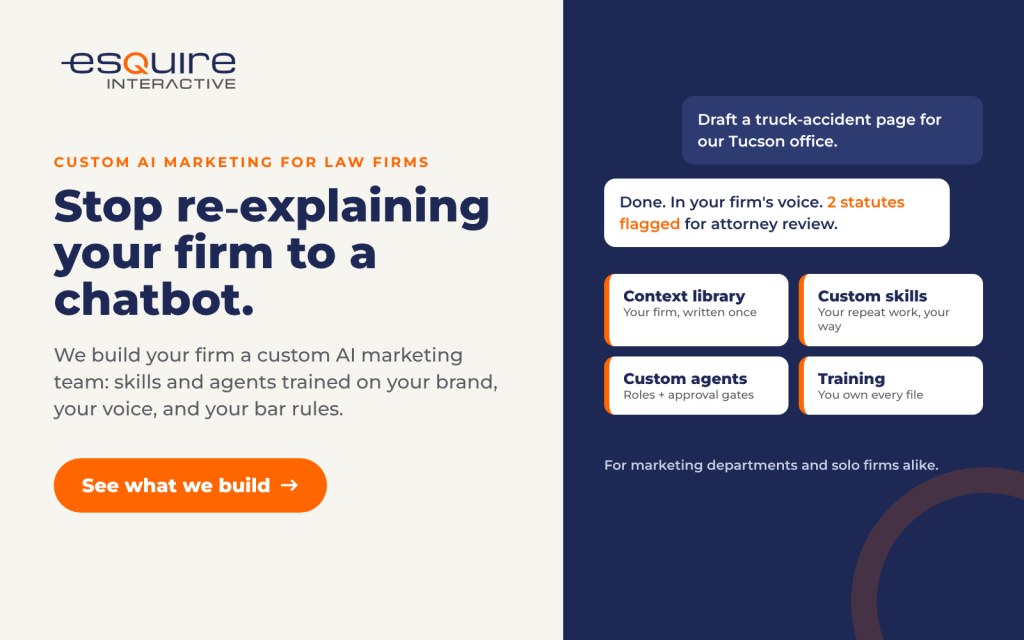
Esquire Interactive helps law firms answer those questions. We select and configure focused AI capabilities for research, drafting, document review, contract analysis, compliance, and other recurring tasks. We call these capabilities AI skills.
Each skill is built around a defined job. We connect it to the appropriate information and systems, establish review requirements, train the team, and continue managing the configuration after launch. The result is a practical tool designed for your firm rather than another subscription your team is expected to figure out on its own.
AI Skills are one part of our broader AI services for law firms.
Which AI Skills Would Help Your Firm?
Tell us which tasks take too long or produce inconsistent results. We will help you identify the simplest useful starting point.
What Is an AI Skill?
An AI skill is a configured capability that helps a user complete a specific task. A research skill may organize authorities responsive to a question. A drafting skill may create a first draft from an approved template and matter information. A contract review skill may extract key terms and flag provisions that need attention.
Most AI skills are initiated by an attorney or staff member. The user provides the document, question, or matter information; the skill performs the assigned task; and the result is returned for review.
The configuration matters as much as the underlying software. A generic tool may know how to summarize a document. A properly configured skill knows what your firm wants included, how the result should be organized, which sources may be used, and who must review it.
AI Skill, AI Agent, or Automated Process?
These services solve different types of problems. We recommend the least complicated option that can perform the work reliably.
- AI skills perform a focused task when a user asks, such as summarizing a record or preparing a first draft.
- AI agents complete a defined, multi-step workflow and may act across several connected systems.
- AI processes automate recurring sequences, approvals, and handoffs.
- AI connectors allow approved information to move between the software a firm already uses.
Learn more about AI Agents, AI Processes, and AI Connectors.
AI Skills Law Firms Can Use
The best opportunities are tasks that occur regularly, use a recognizable structure, and have a clear point for attorney or staff review.
Document Drafting and Review
A drafting skill can prepare a first draft using approved templates, standard clauses, matter information, and firm instructions. Potential uses include memoranda, demand letters, contracts, client communications, and recurring forms.
A review skill works in the other direction. It reads a document, extracts defined information, compares language with an approved standard, and organizes issues for the attorney. These tools can reduce blank-page work and make high-volume review more consistent, but the final analysis remains with the lawyer.
Legal Research
A research skill can search approved sources using a natural-language question and organize potentially relevant cases, statutes, regulations, and secondary materials. It may also prepare an outline showing how the sources relate to the issue.
We configure research skills around the firm’s practice areas and jurisdictions. Verification remains part of the workflow: attorneys must check citations, quotations, current authority, and legal conclusions before relying on the result.
Contract Analysis and Management
A contract analysis skill can extract key terms, identify missing provisions, compare language against an approved playbook, and prepare a structured review summary. Contract drafting skills can then use the firm’s templates and approved clauses to support the next stage of the work.
For firms with recurring contract obligations, related skills can also identify dates, renewal windows, notice requirements, and other terms that need to be transferred into an approved tracking process.
Compliance and Risk Review
Compliance skills can summarize updates from designated sources, compare new guidance with defined criteria, and prepare material for attorney review. Risk-review skills can examine contracts or matter documents for specific issues identified by the firm.
These tools support a more consistent review process during high-volume periods. They do not determine the legal significance of an issue or replace professional judgment.
Practice Management and Client Communication
AI skills can also support everyday operations. A skill may prepare a matter-status summary, draft a routine client update, organize intake information, or analyze approved matter and billing data for internal reporting.
Operational skills are most useful when they fit naturally into the systems attorneys and staff already use. If a task requires several applications or multiple steps to run without user initiation, an AI agent or automated process may be a better fit.
Start With a Task Your Team Knows Well
A focused skill is easier to test, train, and measure. Once it works reliably, the firm can decide whether to expand it or address another workflow.
How We Choose and Configure AI Skills
Our process begins with the task, not the product. We look at how the work is completed today and what a useful result should look like.
- Assess the task. We review the workflow, frequency, users, source information, current software, and required professional judgment.
- Define the expected result. We establish what the skill should produce, which sources it may use, what it must not do, and who reviews the output.
- Select the right technology. Because we are vendor-agnostic, we recommend tools based on fit, security, usability, and cost.
- Configure the skill. We incorporate approved instructions, templates, terminology, output formats, and review requirements.
- Test with representative work. The skill is evaluated against ordinary tasks, difficult examples, and known exceptions before launch.
- Train the team. Attorneys and staff receive practical guidance on when to use the skill, how to review its work, and when to stop or escalate.
- Monitor and improve. We review performance and adjust the configuration as the firm’s work and the underlying technology change.
Confidentiality, Security, and Attorney Oversight
Law firms should evaluate AI tools on more than output quality. Data storage, access controls, model training practices, source reliability, and professional responsibility obligations all need to be considered.
Before recommending a tool, we review how it handles information, whether customer data may be used for model training, what security and administrative controls are available, and how the proposed workflow will use client or firm data. The appropriate requirements depend on the task, jurisdiction, practice area, and information involved.
Every legal workflow includes defined human review. Attorneys remain responsible for legal judgment and work product. Depending on the project, we may also provide role-based access, usage policies, approved-source lists, verification protocols, training materials, and activity records.
For a broader discussion of firm governance, read Ethics, Confidentiality & AI: How to Develop a Strong Law Firm AI Policy Before It’s Too Late.
Why Law Firms Choose Esquire Interactive
Esquire Interactive has worked with law firms since 2007. Our attorney-led perspective helps us evaluate whether a tool fits the realities of legal work, including the need for confidentiality, reliable sources, clear supervision, and practical adoption by attorneys and staff.
We are not tied to a particular AI provider. If the firm’s existing software can support the task, we build around it. If a simpler automation would work better than an AI skill, we recommend the simpler approach.
Our role also continues after deployment. We monitor the skills we configure, update them as tools change, and refine the workflow as the practice evolves. Where appropriate, FirmMetrics® helps connect implementation with meaningful measures such as time, adoption, consistency, cost, and capacity.
Find the right AI skills for your firm.
Schedule a free consultation to discuss the tasks your team performs most often and where a focused AI capability could make a measurable difference.